
Best Vitamin K2 Supplements for Bone Health in 2026
Vitamin K2 MK-7 activates osteocalcin and matrix GLA protein, directing calcium into bones and away from arteries.
Human-RCT / Epidemiological-Strong

This content is for educational purposes only and is not medical advice. These statements have not been evaluated by the FDA. This product is not intended to diagnose, treat, cure, or prevent any disease. Always consult your healthcare provider before starting any supplement.
Best Vitamin K2 for Bone Health in 2026
Ranked by quality, value, and clinical backing
Where available, we show when each product price was last checked so the list stays honest without overreacting to normal Amazon price movement.

Sports Research Vitamin K2 MK-7 100mcg
Our top pick. The combination of 100mcg MK-7 (the clinically validated form and dose) + coconut MCT oil carrier (maximizing fat-soluble absorption) + Non-GMO Verified certification + 8,200 reviews at 4.6★ makes this the best overall choice for most K2 buyers. MCT oil co-formulation is a meaningful advantage — K2's fat-soluble absorption depends significantly on the presence of dietary fat. Sports Research's transparency on the carrier oil is better than most competitors.
- MK-7 only — no K1 or MK-4 for users seeking a multi-form complex
- 60 softgels = 2-month supply at 1/day
Affiliate link: If you buy through this link, we may earn a commission at no extra cost to you.
Buy Sports Research Vitamin K2 MK-7 100mcg
NOW Foods MK-7 Vitamin K-2 100mcg
Best choice for soy-sensitive buyers. Many MK-7 products are derived from natto fermentation and may retain soy allergens — NOW Foods explicitly formulates this as soy-free, which is meaningful for the significant population with soy sensitivity. The main gap vs Sports Research is less transparent carrier oil disclosure.
- Carrier oil not specified — take with a fat-containing meal to ensure absorption
- Slightly lower review rating (4.5★) than Sports Research
Affiliate link: If you buy through this link, we may earn a commission at no extra cost to you.
Buy NOW Foods MK-7 Vitamin K-2 100mcg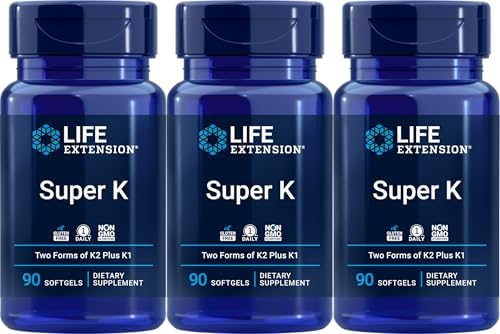
Life Extension Super K with Advanced K2 Complex
The multi-form K specialist. If you want K1 + MK-4 + MK-7 in one capsule — addressing all three K-vitamin roles simultaneously — this is the only product on the list that delivers all three. K1 for coagulation support; MK-4 for bone tissue-specific activity; MK-7 for sustained systemic activation of osteocalcin and MGP. Best for users who want comprehensive K coverage rather than just MK-7. Important: the K1 content (1,000mcg) makes warfarin interaction more significant than MK-7-only products.
- High K1 content (1,000mcg) increases warfarin interaction risk vs MK-7-only products
- Complex formula may be more than most users need
Affiliate link: If you buy through this link, we may earn a commission at no extra cost to you.
Buy Life Extension Super K with Advanced K2 ComplexCompare supplements with the same checklist we use.
Get the anti-aging supplement cheat sheet with evidence prompts, safety checks, and label-quality questions before you buy.
Comparison Table
| Category | #1 Sports Research Vitamin K2 MK-7 100mcg Sports Research | #2 NOW Foods MK-7 Vitamin K-2 100mcg NOW Foods | #3 Life Extension Super K with Advanced K2 Complex Life Extension |
|---|---|---|---|
| Score | 9.4/10 | 9/10 | 8.6/10 |
| Best For | Most K2 buyers who want the clinically validated form (MK-7) with fat-absorption enhancement at the best trust-to-value ratio | Soy-sensitive buyers, and those who want the best price per serving on 100mcg MK-7 | Users who want comprehensive multi-form vitamin K coverage in a single capsule |
| Pros |
|
|
|
| Cons |
|
|
|
What to Know About Vitamin K2 for Bone Health
Vitamin K2 occupies a critical gap in most bone health supplement stacks: it is the activating factor that determines where calcium in your body actually goes. Without sufficient K2, calcium absorbed from diet or supplements is less effectively directed into bone matrix — and may be more likely to deposit in soft tissue including arterial walls. This is the mechanistic explanation for what researchers call the 'calcium paradox.' The two proteins that determine calcium routing are osteocalcin (synthesized in bone by osteoblasts; when activated by K2, it binds calcium into hydroxyapatite crystal structure in bone matrix) and matrix GLA protein (MGP; found throughout the vasculature and soft tissue; when activated by K2, it prevents calcium from crystallizing in arterial walls). Both proteins require vitamin K2-dependent carboxylation to become active. Without adequate K2, both osteocalcin and MGP remain in their inactive (undercarboxylated) forms. The critical product selection variable that most competitors ignore: **MK-7 is not the same as MK-4, and MK-4 is not the same as K1.** MK-7 has a half-life of approximately 3 days — providing sustained circulating levels from a single daily dose of 100-200mcg. MK-4 has a half-life of approximately 6 hours and requires multiple daily doses to maintain consistent plasma levels at typical supplement amounts. K1 (phylloquinone) is primarily hepatic (liver-directed) and does not effectively activate osteocalcin or MGP in peripheral tissues. Form matters enormously for vitamin K2. The Rotterdam Study (Geleijnse et al., 2004, PMID 15514282, n=4,807) showed that dietary menaquinone (MK-7 specifically) was associated with a 57% lower risk of cardiovascular mortality and reduced aortic calcification — an association not seen with vitamin K1. This makes vitamin K2 MK-7 one of the rare supplements with both bone health and cardiovascular health evidence in large epidemiological research.
This content is for educational purposes only and is not medical advice. These statements have not been evaluated by the FDA. This product is not intended to diagnose, treat, cure, or prevent any disease.
Key Benefits of Vitamin K2 for Bone Health
Activates osteocalcin — the bone matrix protein that binds calcium into hydroxyapatite crystal structure — through vitamin K2-dependent carboxylation; without K2, osteocalcin remains inactive and calcium cannot be effectively incorporated into bone matrix regardless of calcium intake
Activates matrix GLA protein (MGP) in arterial walls, preventing calcium crystallization in vascular tissue — the mechanism underlying the potential cardiovascular benefit of K2 and the 57% lower cardiovascular mortality association in the Rotterdam Study (Geleijnse 2004, PMID 15514282)
MK-7's 3-day plasma half-life provides sustained systemic K2 availability from a single 100-200mcg daily dose — unlike MK-4 (6-hour half-life) which requires multiple daily doses to maintain consistent levels at typical supplement quantities
How Vitamin K2 Supports Bone Health
Vitamin K is a cofactor for the enzyme gamma-glutamyl carboxylase, which adds carboxyl groups to specific glutamate residues in vitamin K-dependent proteins — a process called carboxylation. Carboxylation is required for these proteins to bind calcium and become biologically active. **Osteocalcin and bone mineralization.** Osteocalcin is a protein synthesized by osteoblasts (bone-building cells) that becomes activated when carboxylated by K2. Activated (carboxylated) osteocalcin has three calcium-binding domains that bind calcium ions and incorporate them into the hydroxyapatite mineral structure of bone matrix — essentially anchoring calcium in bone. When K2 is insufficient, osteocalcin remains undercarboxylated (ucOC), cannot effectively bind calcium, and bone mineral incorporation is impaired. Blood levels of ucOC are a validated biomarker of K2 status; higher ucOC indicates more severe K2 deficiency. **Matrix GLA protein (MGP) and arterial calcification.** MGP is expressed in vascular smooth muscle cells, chondrocytes, and other soft tissues. Like osteocalcin, it requires carboxylation by K2 to become active. Activated MGP is the primary inhibitor of vascular calcification — it prevents calcium phosphate crystals from forming in arterial walls. Without sufficient K2, MGP remains inactive and cannot suppress arterial calcium deposition. This is the mechanistic basis for the 'calcium paradox': taking calcium without K2 may increase circulating calcium availability, but without activated MGP, that calcium is more vulnerable to depositing in arteries rather than being directed exclusively to bone. **Why MK-7 and not K1 or MK-4?** The three forms differ in their tissue distribution, half-life, and biological activity: - **Vitamin K1 (phylloquinone)**: Found in green vegetables; primarily taken up by the liver for coagulation factor synthesis; relatively poor uptake in bone and vascular tissue. Does not effectively activate osteocalcin or MGP in peripheral tissues. - **MK-4 (menaquinone-4)**: Shorter-chain form; half-life ~6 hours; present in some animal foods. Active in bone and brain tissue. At pharmacological doses (45mg/day, used in Japanese pharmaceutical protocols), MK-4 has strong RCT evidence for bone density. At typical supplement doses (1mg), the 6-hour half-life creates significant gaps in K2 availability unless taken multiple times daily. - **MK-7 (menaquinone-7)**: Long-chain form produced by Bacillus subtilis fermentation (natto); half-life ~3 days; excellent peripheral tissue distribution including bone and vascular tissue. At 100-200mcg/day, MK-7 produces sustained elevated K2 levels that activate osteocalcin and MGP throughout the day. The Rotterdam Study's cardiovascular benefit was specifically associated with MK-7 dietary intake. **The D3 + K2 + calcium stack.** Vitamin D3 increases intestinal calcium absorption — which is beneficial for bone health but also increases circulating calcium. K2 ensures that elevated circulating calcium is directed to bone (via activated osteocalcin) and prevented from depositing in arteries (via activated MGP). The combination of D3 + K2 + calcium is mechanistically coherent: D3 increases calcium availability, K2 directs it appropriately, calcium provides the substrate. Taking high-dose D3 without K2 may increase the theoretical risk of soft tissue calcium deposition.
Vitamin K2 directs calcium into bone via osteocalcin activation; collagen for bone health provides the organic protein scaffold that mineralized calcium actually binds to — both are needed for true bone quality.
Without adequate K2, supplemental calcium can deposit in arteries rather than bone — taking vitamin K2 alongside calcium for bone density ensures the mineral reaches the right tissue.
What to Look For When Buying Vitamin K2
**MK-7 vs MK-4: which should I choose?** For most users, MK-7 at 100-200mcg/day is the better practical choice. The 3-day half-life means a single daily dose maintains consistently elevated K2 plasma levels. The Rotterdam Study's cardiovascular associations were specifically tied to MK-7 dietary intake. RCTs like Knapen 2013 use MK-7 at 180mcg/day. MK-4 has its own RCT evidence base — particularly at very high doses (45mg/day) used in Japanese clinical trials for osteoporosis. But at typical supplement doses (1mg or less), MK-4's 6-hour half-life means plasma K2 levels from a once-daily supplement will be low for most of the day. If you want MK-4, consider taking it 2-3 times daily, or choose a multi-form product that includes MK-7 for the sustained baseline. **Does K2 MK-7 come from soy?** Most MK-7 is produced by Bacillus subtilis fermentation of soy natto. The fermentation process typically reduces soy protein content significantly, but some products may retain detectable soy allergens. If you have soy sensitivity or allergy, look explicitly for soy-free labeled products (NOW Foods MK-7 on this list is explicitly soy-free). Some premium MK-7 forms (such as MenaQ7 brand) are tested to confirm minimal soy residue. **How much K2 do I need?** The evidence-based range for MK-7 supplementation is 100-200mcg/day. The Knapen 2013 RCT used 180mcg/day for 3 years with significant bone and osteocalcin outcomes. The Rotterdam Study's dietary benefit was associated with menaquinone intakes of approximately 32mcg/day from food — suggesting that even moderate dietary amounts are meaningful. Supplemental 100-200mcg/day is substantially above typical dietary intake and is the range most likely to produce measurable changes in undercarboxylated osteocalcin. **Do I need to take K2 with vitamin D3?** Not required, but increasingly recommended. The rationale: vitamin D3 increases intestinal calcium absorption; K2 directs that calcium appropriately via osteocalcin and MGP activation. Taking high-dose D3 (>2,000 IU/day) without K2 may increase circulating calcium in a context of suboptimal MGP activation. Many integrative medicine practitioners recommend D3 + K2 + calcium as a stack rather than any of the three individually.
Dosage Guidance
Always follow your healthcare provider's recommendations. Dosages vary by individual health status, age, and goals.
Common Vitamin K2 Complaints (And How to Avoid Them)
Based on analysis of thousands of customer reviews across Vitamin K2 products.
"I'm already taking calcium and vitamin D. Why would I add K2?"
Calcium provides the mineral substrate and D3 increases calcium absorption — but neither determines where that calcium goes in your body. K2 activates osteocalcin (which anchors calcium into bone matrix) and matrix GLA protein (which prevents calcium from depositing in arteries). Without K2, some research suggests that elevated circulating calcium from supplementation may have suboptimal bone incorporation and theoretically increased vascular calcification risk. K2 is the third leg of the bone health stack, not a redundancy with D3 or calcium.
"Is MK-7 or MK-4 better? Products list both."
For most users, MK-7 at 100-200mcg/day is the better practical choice. MK-7's 3-day half-life provides sustained K2 levels from a single daily dose. MK-4 has strong evidence at very high pharmacological doses (45mg/day in Japanese osteoporosis trials) but at typical supplement doses (1mg or less), its 6-hour half-life means inadequate sustained coverage. The Rotterdam Study's cardiovascular associations were with MK-7 specifically. Choose MK-7 unless your physician has a specific reason to direct you toward MK-4.
"I'm on warfarin — can I take K2?"
You must discuss this with your physician before starting. Warfarin works by blocking vitamin K's role in activating clotting factors — any additional vitamin K (K1 or K2) can reduce warfarin's effect and require dose adjustment. Importantly, some research suggests that consistent K2 intake (stable supplemental dose) may allow INR to be re-stabilized at a new warfarin dose, rather than requiring K2 to be eliminated entirely. But this requires physician monitoring. Do not self-supplement with K2 while on warfarin.
"Do I really need to take K2 with food/fat?"
Yes — this is not a minor detail. Vitamin K2 is fat-soluble; absorption without dietary fat is significantly lower. In trials showing absorption, K2 was typically measured after fat-containing meals. Products containing MCT oil (like Sports Research) partially address this in the formulation itself, but taking with a fat-containing meal remains the best practice for any K2 product. If you take K2 on an empty stomach, you may be absorbing substantially less than the label dose.
Safety & Interactions
- Pregnancy and breastfeeding: Consult your healthcare provider before taking this supplement during pregnancy or while nursing. The safety of supplemental doses beyond dietary intake has not been established in pregnant or lactating women.
- Blood thinners: If you take blood-thinning medications (e.g., warfarin, apixaban, rivaroxaban, clopidogrel, or high-dose aspirin), consult your healthcare provider BEFORE starting this supplement, as it may have additive antiplatelet or anticoagulant effects.
- Kidney disease: If you have chronic kidney disease (CKD) or any significant kidney impairment, consult your healthcare provider before taking this supplement. Some supplements can accumulate to dangerous levels when kidney function is reduced.
- Gout: Individuals with gout should consult their healthcare provider before starting this supplement. Certain supplements (e.g., collagen, fish oil, niacin) may affect uric acid levels or trigger flares in susceptible individuals.
- Fish allergy - capsule source: Some softgel capsules use fish-derived gelatin even when the active supplement is not fish-derived. If you have a confirmed fish or shellfish allergy, verify the capsule source on the label or check with the manufacturer. Vegan capsules (vegetable cellulose) are widely available alternatives.
- Beef / alpha-gal allergy - capsule source: Many softgel and two-piece capsules use bovine gelatin. If you have a confirmed beef allergy or alpha-gal syndrome (mammalian meat allergy), check capsule sources on the label. Vegan capsules (vegetable cellulose) and HPMC capsules are alternatives.
""The vitamin K2 category is poorly understood by most consumers and many practitioners, who conflate K1 and K2 or assume K1 supplementation covers bone health needs. The mechanistic distinction — K2 activates peripheral proteins (osteocalcin, MGP) while K1 primarily activates hepatic coagulation factors — is the entire basis for why K2 is a distinct supplement category. The MK-7 vs MK-4 half-life distinction (3 days vs 6 hours) has real practical implications for product selection at supplement doses: 100mcg MK-7 once daily is more pharmacologically sound than 1mg MK-4 once daily. The cardiovascular angle from the Rotterdam Study is underreported in most K2 content and represents a compelling secondary hook for buyers primarily seeking bone health but also concerned about arterial calcification — a population that significantly overlaps with the calcium/D3 supplement market."
— Angelique Nicole R. Villegas, RND, Registered Nutritionist Dietitian · PRC Philippines · License #0023950
Frequently Asked Questions
Citations & Research
This page references peer-reviewed research indexed on PubMed/NCBI. Citations are provided for transparency. Always consult a qualified healthcare professional before making any medical decisions.
- [1]Ma ML, Ma ZJ, He YL et al. Efficacy of vitamin K2 in the prevention and treatment of postmenopausal osteoporosis: A systematic review and meta-analysis of randomized controlled trials. Frontiers in public health. 2022;10:979649.PMID 36033779 ↗
- [2]Knapen MH, Drummen NE, Smit E, Vermeer C, Theuwissen E. Three-year low-dose menaquinone-7 supplementation helps decrease bone loss in healthy postmenopausal women. Osteoporos Int. 2013;24(9):2499-2507.PMID 23525894 ↗
- [3]Beulens JW, Bots ML, Atsma F, et al. High dietary menaquinone intake is associated with reduced coronary calcification. Atherosclerosis. 2009;203(2):489-493.PMID 19179058 ↗
Ready to Try Vitamin K2?
Our top pick for bone health. Third-party tested, highly reviewed.
Affiliate link: If you buy through this link, we may earn a commission at no extra cost to you.
Shop #1 Pick — Sports Research Vitamin K2 MK-7 100mcgContinue exploring
- our Vitamin K2 guideSupplement overview
- our bone health supplement guideGoal overview
- how Boron supports bone healthAlternative supplement
- Collagen for bone healthAlternative supplement
- best Vitamin K2 for cardiovascular healthSame supplement, different goal
- our top Magnesium pick for bone healthEditor pick
- vitamin k2 mk4 vs vitamin k2 mk7: our verdictCompare options
Get the evidence-graded supplement cheat sheet.
Evidence prompts, safety checks, and label-quality questions before you buy — free, straight to your inbox.
No spam. Unsubscribe anytime.