
Best Vitamin K2 Supplements for Cardiovascular Health in 2026
MK-7 vitamin K2 activates matrix GLA protein to reduce arterial calcification — Rotterdam Study evidence, warfarin interaction warning, and best MK-7 picks.

This content is for educational purposes only and is not medical advice. These statements have not been evaluated by the FDA. This product is not intended to diagnose, treat, cure, or prevent any disease. Always consult your healthcare provider before starting any supplement.
Best Vitamin K2 for Cardiovascular Health in 2026
Ranked by quality, value, and clinical backing
Where available, we show when each product price was last checked so the list stays honest without overreacting to normal Amazon price movement.

Sports Research Vitamin K2 MK-7 100mcg
Most adults seeking cardiovascular-focused K2 MK-7 supplementation at best value
- MK-7 only — no K1 or MK-4 for users wanting a multi-form complex
- 60 softgels = 2-month supply at one per day
Affiliate link: If you buy through this link, we may earn a commission at no extra cost to you.
Buy Sports Research Vitamin K2 MK-7 100mcg
NOW Foods MK-7 Vitamin K-2 100mcg
Soy-sensitive buyers and those wanting best value per serving at the 100mcg MK-7 dose
- Carrier oil not specified — take with a fat-containing meal to ensure absorption
- No MCT oil enhancement
Affiliate link: If you buy through this link, we may earn a commission at no extra cost to you.
Buy NOW Foods MK-7 Vitamin K-2 100mcg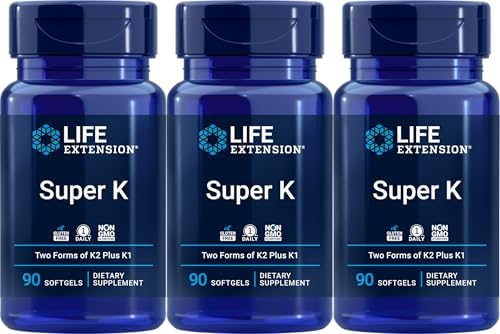
Life Extension Super K with Advanced K2 Complex
Users wanting comprehensive multi-form vitamin K coverage; NOT appropriate for warfarin users without physician guidance
- High K1 content (1,000mcg) significantly increases warfarin interaction risk vs MK-7-only products — see safety notes
- More complex than needed for users who only want cardiovascular K2 support
Affiliate link: If you buy through this link, we may earn a commission at no extra cost to you.
Buy Life Extension Super K with Advanced K2 Complex
Jarrow Formulas MK-7 90mcg
Jarrow brand loyalists seeking natural-fermentation MK-7 with established brand quality
- 90mcg is slightly below the 100mcg standard dose used in most K2 trials
Affiliate link: If you buy through this link, we may earn a commission at no extra cost to you.
Buy Jarrow Formulas MK-7 90mcgCompare supplements with the same checklist we use.
Get the anti-aging supplement cheat sheet with evidence prompts, safety checks, and label-quality questions before you buy.
Comparison Table
| Category | #1 Sports Research Vitamin K2 MK-7 100mcg Sports Research | #2 NOW Foods MK-7 Vitamin K-2 100mcg NOW Foods | #3 Life Extension Super K with Advanced K2 Complex Life Extension | #4 Jarrow Formulas MK-7 90mcg Jarrow Formulas |
|---|---|---|---|---|
| Score | 9.4/10 | 9/10 | 8.7/10 | 8.4/10 |
| Best For | Most adults seeking cardiovascular-focused K2 MK-7 supplementation at best value | Soy-sensitive buyers and those wanting best value per serving at the 100mcg MK-7 dose | Users wanting comprehensive multi-form vitamin K coverage; NOT appropriate for warfarin users without physician guidance | Jarrow brand loyalists seeking natural-fermentation MK-7 with established brand quality |
| Pros |
|
|
|
|
| Cons |
|
|
|
|
What to Know About Vitamin K2 for Cardiovascular Health
Vitamin K2's cardiovascular role is mechanistically distinct from its bone health role — and it is poorly understood even by practitioners familiar with K2 supplementation. The cardiovascular mechanism centers on matrix GLA protein (MGP), a protein expressed in vascular smooth muscle cells and arterial walls. MGP requires vitamin K2-dependent carboxylation (activation) to function. When activated, MGP is the primary inhibitor of vascular calcification — it helps prevent calcium phosphate crystals from forming in arterial tissue. When K2 is insufficient, MGP remains in its inactive (undercarboxylated) form, and calcium is free to deposit in arterial walls. This progression — from undercarboxylated MGP to arterial calcification to cardiovascular disease — is a plausible mechanistic pathway supported by epidemiological evidence. The Rotterdam Study (Geleijnse et al., 2004, PMID 15514282, n=4,807, 10-year follow-up) found that high dietary menaquinone (MK-7) intake was associated with 57% lower risk of coronary heart disease mortality, 52% lower risk of aortic calcification, and 26% lower all-cause mortality. Crucially, these associations were specific to MK-7 — not vitamin K1 (phylloquinone). This form-specificity is mechanistically coherent: K1 is primarily hepatic (liver-directed) and does not effectively activate MGP or osteocalcin in peripheral tissues. WARNING: Vitamin K2 is contraindicated in individuals taking warfarin or other anticoagulant medications without physician supervision. See Safety Notes below.
This content is for educational purposes only and is not medical advice. These statements have not been evaluated by the FDA. This product is not intended to diagnose, treat, cure, or prevent any disease.
Key Benefits of Vitamin K2 for Cardiovascular Health
Vitamin K2 is among the most studied supplements for supporting cardiovascular health.
Multiple human clinical trials have evaluated Vitamin K2's safety and efficacy at common doses.
Vitamin K2 may be particularly relevant for adults over 45 seeking evidence-based support for cardiovascular health.
How Vitamin K2 Supports Cardiovascular Health
Vitamin K2 (particularly MK-7 form) activates Matrix Gla Protein (MGP) — the most potent known inhibitor of vascular calcification. MGP requires vitamin K2-dependent gamma-carboxylation to become biologically active; without adequate K2, uncarboxylated MGP (ucMGP) accumulates in arterial walls and cannot prevent calcium deposition. K2 also activates osteocalcin in bone, directing calcium toward bone rather than arteries. This "calcium paradox" — simultaneously preventing arterial calcification and supporting bone mineralization — is K2's primary cardiovascular mechanism. MK-7 has a half-life of approximately 72 hours (vs 2-3 hours for MK-4), providing sustained activation of these carboxylation reactions from once-daily dosing.
What to Look For When Buying Vitamin K2
Products were selected based on: (1) MK-7 form — cardiovascular evidence (Rotterdam Study, Beulens 2009) is specifically linked to MK-7, not K1 or MK-4; (2) dose — 100–200mcg MK-7/day is the evidence-supported range; (3) fat carrier — K2 is fat-soluble; MCT oil co-formulation is a meaningful absorption advantage; (4) soy content — many MK-7 products derive from natto soy fermentation and may retain soy allergens; (5) third-party testing and brand quality; (6) value per mcg MK-7.
Dosage Guidance
Always follow your healthcare provider's recommendations. Dosages vary by individual health status, age, and goals.
Common Vitamin K2 Complaints (And How to Avoid Them)
Based on analysis of thousands of customer reviews across Vitamin K2 products.
"I'm on warfarin. My cardiologist mentioned vitamin K might be an issue."
Your cardiologist is correct — this is the most important safety consideration for vitamin K2. Warfarin blocks vitamin K recycling, and any change in vitamin K intake (K1 from food or K2 from supplements) affects how much warfarin you need to achieve your target INR. The key risk is INR instability from variable K2 intake. Some cardiologists manage stable K2 supplementation in warfarin patients by adjusting warfarin dose to a consistent K2 intake and monitoring INR closely. This requires physician guidance and should never be self-managed. Do not start K2 without explicit physician approval and a plan for INR monitoring.
"I already take vitamin D3. Do I really need to add K2?"
D3 increases intestinal calcium absorption — beneficial for bone density but it also raises circulating calcium levels. K2 activates two proteins that determine where that calcium goes: osteocalcin (directs calcium into bone) and matrix GLA protein (prevents calcium from depositing in arteries). Without sufficient K2, elevated circulating calcium from D3 supplementation has a theoretically higher risk of arterial deposition. Whether this translates to clinically significant cardiovascular risk at D3 doses used in most supplements is debated — but the mechanistic rationale for co-supplementing K2 with D3 is coherent and the risk of K2 at 100mcg/day is very low.
"The Rotterdam Study is observational. How confident can we be in these associations?"
The observational limitation is real and should be acknowledged. The Rotterdam Study found associations — it cannot prove causation. That said, the associations are strong (57% lower cardiovascular mortality), biologically dose-responsive, form-specific (K1 showed no association, MK-7 did), and mechanistically coherent (MGP activation → calcification suppression). The Beulens 2009 EPIC-NL cohort independently replicated the direction and magnitude. The Schurgers 2007 RCT showed MK-7 supplementation reduces ucMGP (the mechanistic biomarker). Taken together, the evidence across different study types consistently supports the hypothesis. Large RCTs are needed for definitive proof.
Safety & Interactions
- Pregnancy and breastfeeding: Consult your healthcare provider before taking this supplement during pregnancy or while nursing. The safety of supplemental doses beyond dietary intake has not been established in pregnant or lactating women.
- Blood thinners: If you take blood-thinning medications (e.g., warfarin, apixaban, rivaroxaban, clopidogrel, or high-dose aspirin), consult your healthcare provider BEFORE starting this supplement, as it may have additive antiplatelet or anticoagulant effects.
- Kidney disease: If you have chronic kidney disease (CKD) or any significant kidney impairment, consult your healthcare provider before taking this supplement. Some supplements can accumulate to dangerous levels when kidney function is reduced.
- Gout: Individuals with gout should consult their healthcare provider before starting this supplement. Certain supplements (e.g., collagen, fish oil, niacin) may affect uric acid levels or trigger flares in susceptible individuals.
- Fish allergy - capsule source: Some softgel capsules use fish-derived gelatin even when the active supplement is not fish-derived. If you have a confirmed fish or shellfish allergy, verify the capsule source on the label or check with the manufacturer. Vegan capsules (vegetable cellulose) are widely available alternatives.
- Beef / alpha-gal allergy - capsule source: Many softgel and two-piece capsules use bovine gelatin. If you have a confirmed beef allergy or alpha-gal syndrome (mammalian meat allergy), check capsule sources on the label. Vegan capsules (vegetable cellulose) and HPMC capsules are alternatives.
- Blood pressure medications: This supplement may have an additive blood-pressure-lowering effect when taken with antihypertensives including beta-blockers (metoprolol, atenolol), ACE inhibitors (lisinopril), ARBs (losartan), and calcium channel blockers (amlodipine). If you take any blood pressure medication, monitor your readings for the first 4–6 weeks after starting and inform your prescribing physician.
- Important: This supplement is not a replacement for prescription medications. It is supportive for individuals with low baseline status, not a treatment for diagnosed conditions (anxiety disorders, insomnia, hypertension, osteoporosis, etc.). Do not stop or reduce any prescription without consulting your doctor.
""The cardiovascular case for K2 is mechanistically compelling but rests primarily on epidemiological data — the Rotterdam Study and EPIC-NL cohort. The absence of a large prospective RCT powered for hard cardiovascular endpoints (MI, stroke) is a meaningful evidence gap. However, the mechanistic pathway is coherent: K2 → MGP activation → suppression of arterial calcium deposition → reduced calcification progression. The ucMGP biomarker (measurable via a blood test) allows clinicians to assess functional K2 status and track response to supplementation — which is rare in the supplement world. For patients taking D3 + calcium, adding K2 is mechanistically rational and low-risk (absent anticoagulant contraindications). The cardiovascular angle is genuinely underrepresented in K2 marketing, which focuses almost exclusively on bone health."
— Angelique Nicole R. Villegas, RND, Registered Nutritionist Dietitian · PRC Philippines · License #0023950
Frequently Asked Questions
Citations & Research
This page references peer-reviewed research indexed on PubMed/NCBI. Citations are provided for transparency. Always consult a qualified healthcare professional before making any medical decisions.
- [c1]Geleijnse JM, Vermeer C, Grobbee DE, et al. “Dietary intake of menaquinone is associated with a reduced risk of coronary heart disease: the Rotterdam Study.” J Nutr, 2004. 4807. doi:10.1093/jn/134.11.3100PMID 15514282 ↗
- [c2]Gast GC, de Roos NM, Sluijs I, Bots ML, et al. “A high menaquinone intake reduces the incidence of coronary heart disease.” Nutr Metab Cardiovasc Dis, 2009. doi:10.1016/j.numecd.2008.10.004PMID 19179058 ↗
- [c3]Schurgers LJ, Teunissen KJ, Hamulyak K, Knapen MH, Vik H. “Vitamin K-containing dietary supplements: comparison of synthetic vitamin K1 and natto-derived menaquinone-7.” Blood, 2007. doi:10.1182/blood-2006-08-040709PMID 17158229 ↗
- [c4]Rønn SH, Harsløf T, Oei L, Pedersen SB. “The effect of vitamin MK-7 on bone mineral density and microarchitecture in postmenopausal women with osteopenia, a 3-year randomized, placebo-controlled clinical trial.” Osteoporos Int, 2021. 325. doi:10.1007/s00198-020-05638-zPMID 33030563 ↗
Ready to Try Vitamin K2?
Our top pick for cardiovascular health. Third-party tested, highly reviewed.
Affiliate link: If you buy through this link, we may earn a commission at no extra cost to you.
Shop #1 Pick — Sports Research Vitamin K2 MK-7 100mcgContinue exploring
- see all Vitamin K2 usesSupplement overview
- our cardiovascular health supplement guideGoal overview
- clinical notes on CoQ10 and cardiovascular healthAlternative supplement
- the Fish Oil page for cardiovascular healthAlternative supplement
- how Vitamin K2 supports bone healthSame supplement, different goal
- vitamin k2 mk4 vs vitamin k2 mk7: our verdictCompare options
Get the evidence-graded supplement cheat sheet.
Evidence prompts, safety checks, and label-quality questions before you buy — free, straight to your inbox.
No spam. Unsubscribe anytime.