
Best Lutein Supplements for Eye Health in 2026
AREDS2 showed lutein + zeaxanthin cut advanced AMD risk by 26%. We explain the exact 10mg/2mg dose and rank 4 lutein supplements by evidence match.
AREDS2 RCT, n=4,203

This content is for educational purposes only and is not medical advice. These statements have not been evaluated by the FDA. This product is not intended to diagnose, treat, cure, or prevent any disease. Always consult your healthcare provider before starting any supplement.
Best Lutein for Eye Health in 2026
Ranked by quality, value, and clinical backing
Where available, we show when each product price was last checked so the list stays honest without overreacting to normal Amazon price movement.
Life Extension MacuGuard Ocular Support
Best AREDS2-matched formula. The only product on this list that provides exactly 10mg lutein + 2mg zeaxanthin per softgel — the precise dose studied in the AREDS2 trial — plus meso-zeaxanthin (the third macular carotenoid) and C3G from black currant for additional retinal antioxidant support. For users specifically supplementing for AMD risk, the dose match matters. Olive oil carrier provides fat absorption support.
- 1,900 reviews — smallest trust base on this list
- Meso-zeaxanthin component does not have direct AREDS2 trial evidence

Jarrow Lutein 20mg
Best choice for users who want FloraGLO branded lutein with the largest clinical trial evidence linkage. 20mg per softgel allows flexible dosing — one softgel for higher-dose protocols, or half (by splitting the bottle budget) for AREDS2 maintenance. The 5,200 reviews and established FloraGLO brand provide strong confidence. Zeaxanthin is underdosed at 800mcg for strict AREDS2 compliance.
- 800mcg zeaxanthin — below AREDS2 2mg target; additional zeaxanthin supplement may be needed
- 20mg per softgel is double the AREDS2 lutein dose — potential overshot for maintenance users
Affiliate link: If you buy through this link, we may earn a commission at no extra cost to you.
Buy Jarrow Lutein 20mg
NOW Foods Lutein 20mg with Zeaxanthin
Best value option with the highest review count (6,800). Zeaxanthin at 1mg is closer to the AREDS2 target than most competitors but still falls short of the 2mg studied dose. Best for budget-conscious users or those new to lutein supplementation.
- 1mg zeaxanthin — still below AREDS2 2mg target
- No branded lutein ingredient (FloraGLO equivalent) on label
- Rice bran oil is a lighter fat carrier
Affiliate link: If you buy through this link, we may earn a commission at no extra cost to you.
Buy NOW Foods Lutein 20mg with Zeaxanthin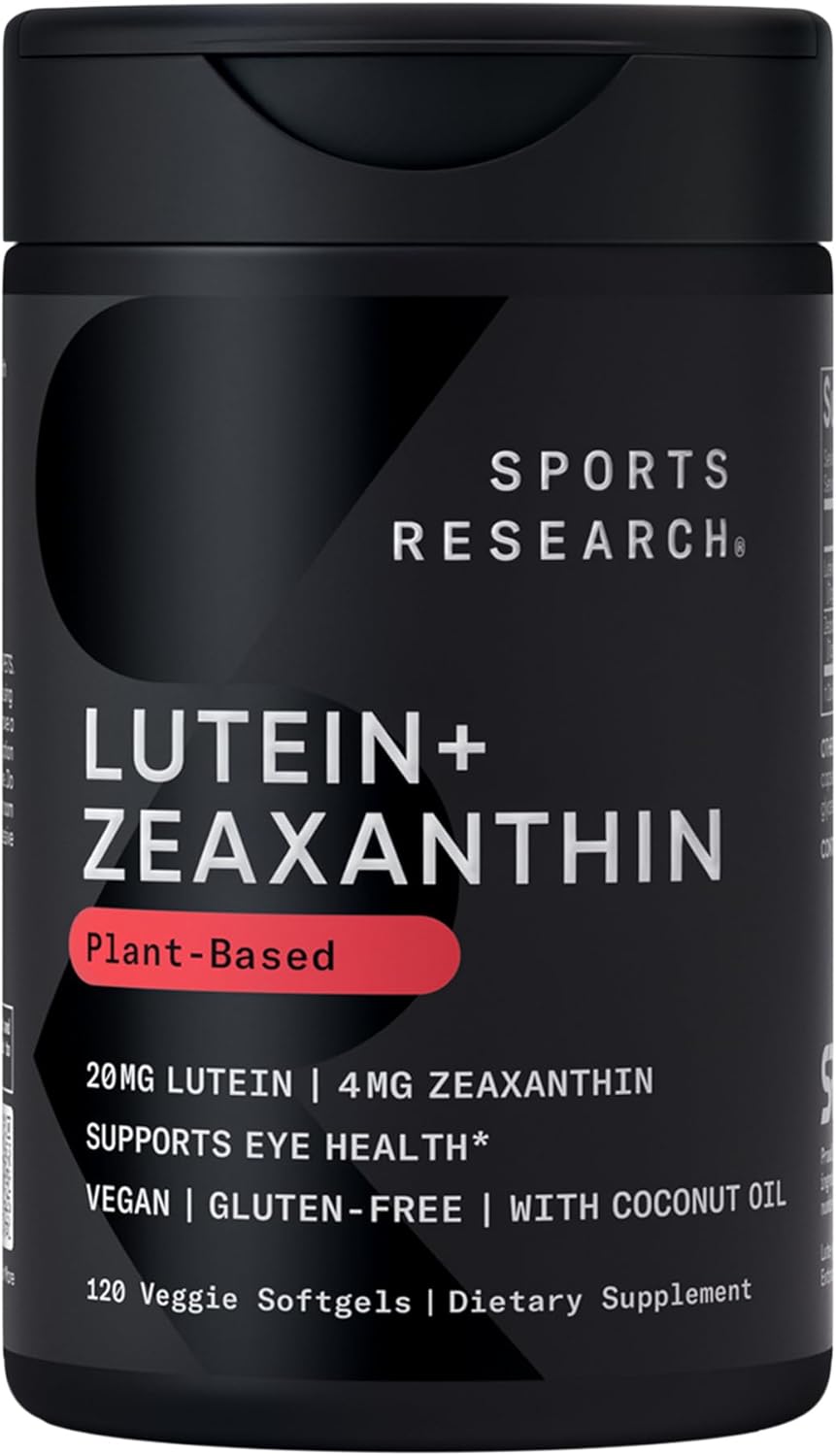
Sports Research Lutein 20mg
Best for users who want FloraGLO branded lutein with built-in fat absorption via organic coconut oil. Sports Research's Non-GMO Project Verification adds a layer of transparency. The zeaxanthin shortfall (800mcg) is the same as Jarrow — both use FloraGLO at 20mg and both fall short on zeaxanthin. Choose between this and Jarrow based on preference for coconut oil vs. safflower oil carrier.
- 800mcg zeaxanthin — below AREDS2 2mg target
- Coconut oil (saturated fat) may be a consideration for some users
- 20mg lutein is double the AREDS2 dose for those targeting the studied amount
Affiliate link: If you buy through this link, we may earn a commission at no extra cost to you.
Buy Sports Research Lutein 20mgCompare supplements with the same checklist we use.
Get the anti-aging supplement cheat sheet with evidence prompts, safety checks, and label-quality questions before you buy.
Comparison Table
| Category | #1 Life Extension MacuGuard Ocular Support Life Extension | #2 Jarrow Lutein 20mg Jarrow Formulas | #3 NOW Foods Lutein 20mg with Zeaxanthin NOW Foods | #4 Sports Research Lutein 20mg Sports Research |
|---|---|---|---|---|
| Score | 9.2/10 | 8.8/10 | 8.5/10 | 8.3/10 |
| Best For | Users following AREDS2 protocol who want a single-softgel dose match with the studied formula | Users who want the clinical confidence of FloraGLO branded lutein and are willing to add a separate zeaxanthin source | Budget-conscious users or those beginning lutein supplementation who want the highest review confidence at the lowest cost | Users who want FloraGLO branded lutein with automatic fat delivery and Non-GMO verification |
| Pros |
|
|
|
|
| Cons |
|
|
|
|
What to Know About Lutein for Eye Health
Lutein and zeaxanthin are the only two carotenoids the human body deposits specifically in the retina, where they form the macular pigment — a yellow filter layer concentrated at the center of vision. The macula is the most metabolically active and oxygen-demanding tissue in the body; it processes 90% of the visual information we actually use and is simultaneously bombarded by high-energy blue light and UV radiation. Macular pigment is the eye's primary defense against this oxidative onslaught. The AREDS2 trial (Age-Related Eye Disease Study 2, PMID 23644932) is the landmark evidence for this category — a 5-year, 4,203-participant, double-blind RCT funded by the National Eye Institute. Participants supplementing with 10mg lutein + 2mg zeaxanthin per day showed a 26% reduction in risk of progression to advanced AMD compared to those receiving beta-carotene instead. This is one of the largest and most rigorous supplement trials ever conducted, and it fundamentally changed clinical ophthalmology's view of nutritional supplementation for eye aging. The purchasing insight most lutein content misses: the AREDS2 dose is specifically 10mg lutein AND 2mg zeaxanthin. Many products provide the lutein component at 20mg or more but underdose zeaxanthin to 0.8-1mg. If you are supplementing for AREDS2-level eye protection, zeaxanthin at 2mg is part of the formula — not optional. This page ranks products on both components of that ratio.
This content is for educational purposes only and is not medical advice. These statements have not been evaluated by the FDA. This product is not intended to diagnose, treat, cure, or prevent any disease.
Key Benefits of Lutein for Eye Health
Research suggests support for reducing AMD progression risk — AREDS2 RCT (PMID 23644932, n=4,203) showed 26% reduction in advanced AMD risk with 10mg lutein + 2mg zeaxanthin per day over 5 years, one of the strongest supplement RCTs in ophthalmology
Forms macular pigment that filters blue light — lutein and zeaxanthin are the only carotenoids specifically deposited in the macula, where they absorb high-energy blue and UV light before it can damage photoreceptors and retinal pigment epithelium
May support macular pigment optical density (MPOD) — measurable biomarker increases with supplementation, correlating with improved contrast sensitivity and glare recovery in some studies
How Lutein Supports Eye Health
Lutein is a xanthophyll carotenoid — a fat-soluble pigment found in green leafy vegetables (kale, spinach, collard greens) and egg yolks. Unlike beta-carotene, lutein is not a provitamin A — it has no vitamin A precursor activity. Its biological role in humans is primarily structural and antioxidant, concentrated in the retina. **Selective retinal deposition:** Of all the carotenoids in circulation, lutein and zeaxanthin are the only two the retinal pigment epithelium selectively transports and concentrates in the macula. The macula contains approximately 0.1-1mg total carotenoids per gram wet weight — a concentration 1,000-fold higher than most other tissues. This selectivity is mediated by specific lutein-binding proteins (StARD3, GSTP1) expressed in retinal tissue. **Macular pigment blue-light filter:** Once deposited in the inner plexiform and outer plexiform layers of the macula, lutein and zeaxanthin form the macular pigment — the yellow pigment visible on fundoscopy. The yellow color reflects selective absorption of blue light (peak absorption ~450nm), which is the highest-energy visible light wavelength reaching the retina. By absorbing this light before it reaches the photoreceptors, macular pigment acts as an internal sunscreen for the most sensitive visual cells. **Reactive oxygen species quenching:** The macula operates at extraordinary metabolic intensity — the density of photoreceptors and their continuous light-transduction activity generates high levels of reactive oxygen species (ROS), particularly singlet oxygen from photosensitized reactions. Lutein quenches singlet oxygen and peroxyl radicals through its conjugated double-bond system, protecting photoreceptor outer segments and retinal pigment epithelium from oxidative damage. **AMD pathophysiology connection:** Age-related macular degeneration is characterized by the accumulation of drusen (oxidative debris) beneath the retinal pigment epithelium and progressive death of photoreceptors. Oxidative damage to the retinal pigment epithelium is a central mechanistic pathway. Higher macular pigment density — achievable through lutein/zeaxanthin supplementation — is associated with slower accumulation of this oxidative debris. **Fat absorption requirement:** Like all carotenoids, lutein is fat-soluble and requires dietary fat for meaningful intestinal absorption. Bioavailability from supplements taken without fat is significantly reduced. This is the primary reason lutein is formulated in oil-based softgels rather than dry capsules.
What to Look For When Buying Lutein
**The AREDS2 dose: 10mg lutein + 2mg zeaxanthin** The AREDS2 trial used a specific formula: 10mg lutein + 2mg zeaxanthin + 500mg vitamin C + 400 IU vitamin E + 80mg zinc + 2mg copper. For eye health supplementation specifically, the lutein and zeaxanthin components are what most people are seeking from a standalone supplement. The critical point: most lutein supplements provide 20mg lutein but only 0.8-1mg zeaxanthin — less than half the zeaxanthin in the AREDS2 formula. If you are supplementing specifically for AMD risk reduction, the zeaxanthin dose matters. **FloraGLO branded lutein: does it matter?** FloraGLO (from Kemin Industries) is the most widely studied branded lutein ingredient, used as the lutein source in many of the clinical trials behind the AREDS2 rationale. 'FloraGLO lutein' on the label indicates clinical trial traceability. Non-branded lutein supplements from Tagetes erecta (marigold) are the same botanical source and likely equivalent, but the FloraGLO brand provides direct clinical evidence linkage. For high-risk AMD users, branded forms provide additional confidence. **Lutein must be taken with fat** All carotenoids are fat-soluble. Lutein has essentially negligible absorption without dietary fat. Softgels pre-formulated with oil (safflower, coconut, olive, or rice bran) provide the fat carrier automatically. If you choose a dry capsule format, always take it with your fattiest meal of the day. **Should I take a full AREDS2 formula or lutein standalone?** If you have diagnosed intermediate or advanced AMD in one eye, your ophthalmologist will likely recommend the full AREDS2 formula (available as standalone AREDS2 supplements from PreserVision and similar). For general eye health maintenance in adults 40+ without diagnosed AMD, a lutein + zeaxanthin supplement at 10mg/2mg is the most evidence-supported single intervention.
Dosage Guidance
Always follow your healthcare provider's recommendations. Dosages vary by individual health status, age, and goals.
Common Lutein Complaints (And How to Avoid Them)
Based on analysis of thousands of customer reviews across Lutein products.
"My eye doctor told me to take AREDS2 formula — is lutein standalone enough?"
If your ophthalmologist has diagnosed intermediate or advanced AMD in one eye and recommended AREDS2 supplementation, the full AREDS2 formula (including vitamin C, vitamin E, zinc, and copper) is what the trial tested — not lutein alone. Full AREDS2 supplements are available under the PreserVision brand and others. A standalone lutein + zeaxanthin supplement at 10mg/2mg covers the carotenoid component but not the full AREDS2 antioxidant + mineral combination. Discuss with your ophthalmologist whether the full formula or the lutein + zeaxanthin component alone is appropriate for your situation.
"I've been taking lutein for two months and had no change in my vision."
The AREDS2 trial measured reduction in AMD progression risk over 5 years — not subjective improvement in visual acuity in healthy individuals. Lutein supplementation is primarily a preventive and supportive intervention for those with AMD risk factors, not a treatment that visibly improves vision in people without active disease. If you are taking lutein for general eye health maintenance, the benefit is long-term risk reduction rather than perceptible short-term changes. Vision changes warrant evaluation by an ophthalmologist, not adjustment of supplements.
"My lutein supplement only has 1mg zeaxanthin, not 2mg. Does this matter?"
The AREDS2 trial used 2mg zeaxanthin specifically. Most standalone lutein supplements provide 0.8-1mg zeaxanthin, which is below the studied dose. The clinical significance of this gap is uncertain — there is no trial directly comparing 1mg vs. 2mg zeaxanthin outcomes. For general eye health maintenance, 1mg may be sufficient. For users specifically supplementing for AMD risk reduction following the AREDS2 evidence, reaching 2mg zeaxanthin is worth prioritizing — either by choosing a product that provides 2mg (like Life Extension MacuGuard) or by supplementing zeaxanthin separately.
"Can I get enough lutein from food instead of supplements?"
Cooked kale provides approximately 21mg lutein per cup, and cooked spinach provides approximately 20mg per cup — both exceeding the 10mg AREDS2 dose. However, bioavailability from cooked greens depends on fat co-consumption (eating greens with olive oil or eggs significantly increases carotenoid absorption). The average Western dietary lutein intake is estimated at 1-2mg/day — far below the 10mg AREDS2 dose. Consistent dietary sources are ideal, but most people do not eat 1+ cup of cooked leafy greens daily. Supplementation provides a reliable way to reach the studied dose regardless of dietary patterns.
Safety & Interactions
- Pregnancy and breastfeeding: Consult your healthcare provider before taking this supplement during pregnancy or while nursing. The safety of supplemental doses beyond dietary intake has not been established in pregnant or lactating women.
- Blood thinners: If you take blood-thinning medications (e.g., warfarin, apixaban, rivaroxaban, clopidogrel, or high-dose aspirin), consult your healthcare provider BEFORE starting this supplement, as it may have additive antiplatelet or anticoagulant effects.
- Kidney disease: If you have chronic kidney disease (CKD) or any significant kidney impairment, consult your healthcare provider before taking this supplement. Some supplements can accumulate to dangerous levels when kidney function is reduced.
- Gout: Individuals with gout should consult their healthcare provider before starting this supplement. Certain supplements (e.g., collagen, fish oil, niacin) may affect uric acid levels or trigger flares in susceptible individuals.
- Fish allergy - capsule source: Some softgel capsules use fish-derived gelatin even when the active supplement is not fish-derived. If you have a confirmed fish or shellfish allergy, verify the capsule source on the label or check with the manufacturer. Vegan capsules (vegetable cellulose) are widely available alternatives.
- Beef / alpha-gal allergy - capsule source: Many softgel and two-piece capsules use bovine gelatin. If you have a confirmed beef allergy or alpha-gal syndrome (mammalian meat allergy), check capsule sources on the label. Vegan capsules (vegetable cellulose) and HPMC capsules are alternatives.
- Important: This supplement is not a replacement for prescription medications. It is supportive for individuals with low baseline status, not a treatment for diagnosed conditions (anxiety disorders, insomnia, hypertension, osteoporosis, etc.). Do not stop or reduce any prescription without consulting your doctor.
""The lutein category has one persistent content problem: virtually every page on the internet either lists '20mg lutein' as the recommended dose (which overshoots the AREDS2 lutein component and ignores the zeaxanthin ratio) or fails to mention zeaxanthin dosing at all. The AREDS2 trial is the defining piece of evidence in this category, and the formula is 10mg lutein + 2mg zeaxanthin — not '20mg lutein' as most products are positioned. The zeaxanthin shortfall in most standalone lutein supplements is a meaningful gap for users following the AREDS2 evidence. Our ranking prioritizes the Life Extension MacuGuard specifically because it is the only product on this list that delivers the exact AREDS2 lutein + zeaxanthin ratio in a single softgel. The second editorial point: lutein is for prevention and risk reduction in those with AMD risk factors — it is not a treatment for vision loss and should not be framed as a vision-improvement supplement for healthy younger adults."
— Angelique Nicole R. Villegas, RND, Registered Nutritionist Dietitian · PRC Philippines · License #0023950
Frequently Asked Questions
Citations & Research
This page references peer-reviewed research indexed on PubMed/NCBI. Citations are provided for transparency. Always consult a qualified healthcare professional before making any medical decisions.
- [1]Age-Related Eye Disease Study 2 Research Group. Lutein + zeaxanthin and omega-3 fatty acids for age-related macular degeneration: the Age-Related Eye Disease Study 2 (AREDS2) randomized clinical trial. JAMA. 2013;309(19):2005-2015.PMID 23644932 ↗
- [2]Koh HH, Murray IJ, Nolan D, et al. Plasma and macular responses to lutein supplement in subjects with and without age-related maculopathy: a pilot study. Exp Eye Res. 2004;79(1):21-27.PMID 15183097 ↗
- [3]Seddon JM, Ajani UA, Sperduto RD, et al. Dietary carotenoids, vitamins A, C, and E, and advanced age-related macular degeneration. JAMA. 1994;272(18):1413-1420.PMID 7933422 ↗
Ready to Try Lutein?
Our top pick for eye health. Third-party tested, highly reviewed.
Affiliate link: If you buy through this link, we may earn a commission at no extra cost to you.
Shop #1 Pick — Life Extension MacuGuard Ocular SupportContinue exploring
- our full Lutein reviewSupplement overview
- see all eye health supplements we coverGoal overview
- clinical notes on Astaxanthin and eye healthAlternative supplement
- how we rate Omega 3 for eye healthAlternative supplement
- the Lutein page for brain healthSame supplement, different goal
- evidence notes on Lutein + Zeaxanthin for digital eye strainEditor pick
- we tested supplements against food sourcesCompare options
Get the evidence-graded supplement cheat sheet.
Evidence prompts, safety checks, and label-quality questions before you buy — free, straight to your inbox.
No spam. Unsubscribe anytime.