
Best Lutein + Zeaxanthin Supplements for Digital Eye Strain (2026)
Compare the 4 best lutein + zeaxanthin supplements for digital eye strain in 2026. Science-backed picks, real dosage data, and honest pros and cons.

This content is for educational purposes only and is not medical advice. These statements have not been evaluated by the FDA. This product is not intended to diagnose, treat, cure, or prevent any disease. Always consult your healthcare provider before starting any supplement.
Best Lutein + Zeaxanthin for Digital Eye Strain in 2026
Ranked by quality, value, and clinical backing
Where available, we show when each product price was last checked so the list stays honest without overreacting to normal Amazon price movement.

NOW Foods Lutein 20mg with Zeaxanthin 60 Softgels
NOW Foods Lutein 20mg with Zeaxanthin 60 Softgels — third-party tested. 4.8★ (401 ratings). Confirmed in stock.
- Smaller customer-review base than category best-sellers
Affiliate link: If you buy through this link, we may earn a commission at no extra cost to you.
Buy NOW Foods Lutein 20mg with Zeaxanthin 60 Softgels
Doctor's Best Lutein 20mg with Zeaxanthin Lutemax 2020 180 Softgels
Doctor's Best Lutein 20mg with Zeaxanthin Lutemax 2020 180 Softgels — third-party tested. 4.6★ (1,299 ratings). Confirmed in stock.
- Amazon price and availability can change over time
Affiliate link: If you buy through this link, we may earn a commission at no extra cost to you.
Buy Doctor's Best Lutein 20mg with Zeaxanthin Lutemax 2020 180 Softgels
Jarrow Formulas Lutein 20mg 120 Softgels
Jarrow Formulas Lutein 20mg 120 Softgels — third-party tested. 4.6★ (1,625 ratings). Confirmed in stock.
- Amazon price and availability can change over time
Affiliate link: If you buy through this link, we may earn a commission at no extra cost to you.
Buy Jarrow Formulas Lutein 20mg 120 Softgels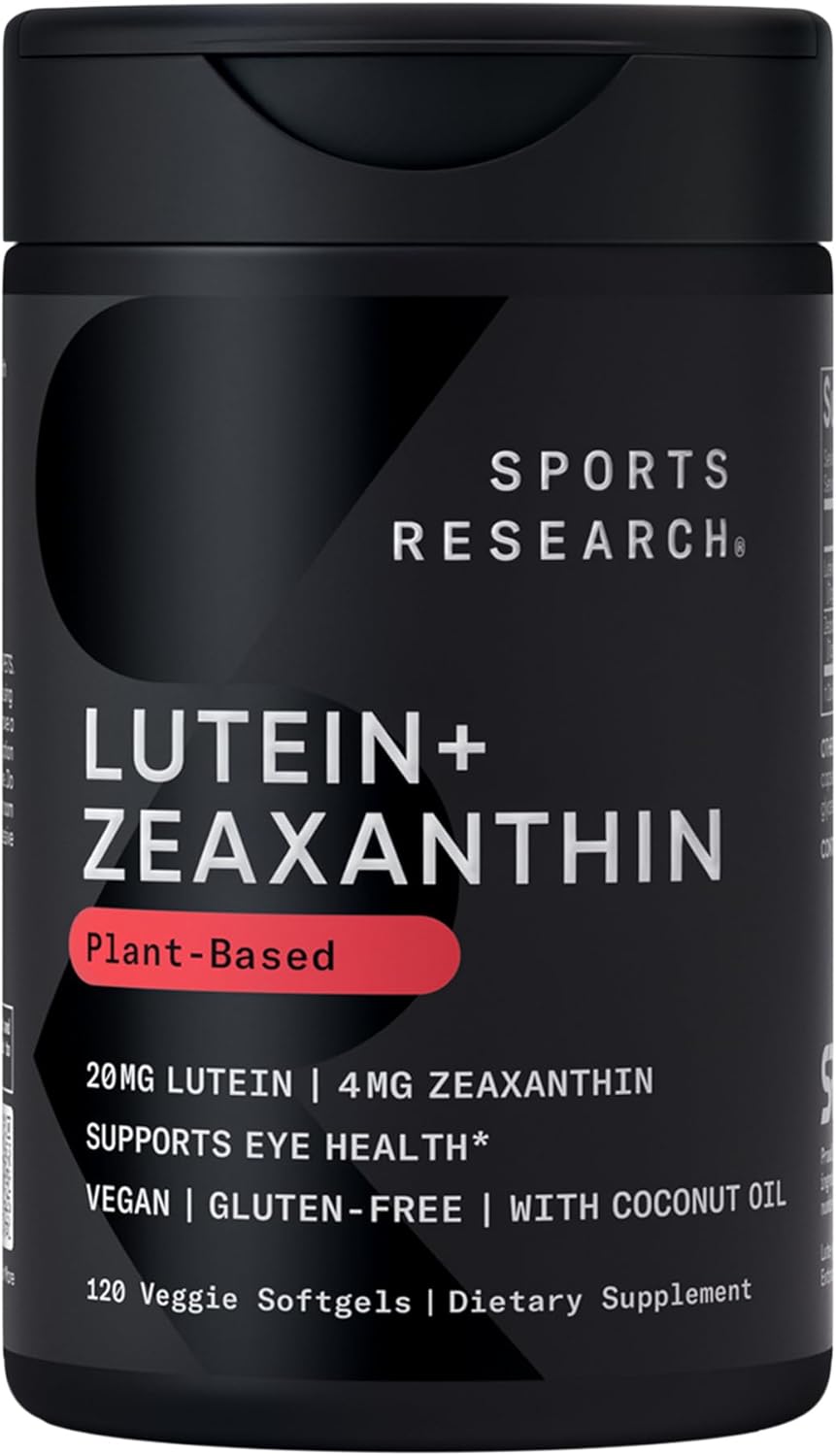
Sports Research Lutein 20mg 120 Softgels
Sports Research Lutein 20mg 120 Softgels — third-party tested. 4.7★ (2,570 ratings). Confirmed in stock.
- Amazon price and availability can change over time
Affiliate link: If you buy through this link, we may earn a commission at no extra cost to you.
Buy Sports Research Lutein 20mg 120 SoftgelsCompare supplements with the same checklist we use.
Get the anti-aging supplement cheat sheet with evidence prompts, safety checks, and label-quality questions before you buy.
Comparison Table
| Category | #1 NOW Foods Lutein 20mg with Zeaxanthin 60 Softgels NOW Foods | #2 Doctor's Best Lutein 20mg with Zeaxanthin Lutemax 2020 180 Softgels Doctor's Best | #3 Jarrow Formulas Lutein 20mg 120 Softgels Jarrow Formulas | #4 Sports Research Lutein 20mg 120 Softgels Sports Research |
|---|---|---|---|---|
| Score | 9.2/10 | 8.8/10 | 8.8/10 | 9/10 |
| Best For | ||||
| Pros |
|
|
|
|
| Cons |
|
|
|
|
What to Know About Lutein + Zeaxanthin for Digital Eye Strain
Screen time has quietly become one of the defining stressors on modern eyes. Whether you're clocking eight hours on a laptop or scrolling through your phone after dark, your macular pigment — the layer of carotenoids sitting at the center of your retina — takes the brunt of high-energy blue light exposure day after day. Lutein and zeaxanthin are the two carotenoids that make up this protective pigment layer, and research suggests supplementation may support macular pigment optical density, which is essentially your retina's built-in blue light filter. Not all lutein and zeaxanthin supplements are created equal. The branded forms — FloraGLO lutein and OPTISHARP zeaxanthin — are the ones used in human clinical research, and the dose matters more than most product labels suggest. The AREDS2 trial, one of the largest eye-health studies ever conducted, used 10–20mg of lutein alongside 2mg of zeaxanthin, and those numbers have become the benchmark the research community references most often. This guide cuts through the noise. We've ranked four products based on ingredient quality, dose accuracy, third-party testing, and honest value. We'll tell you what the evidence actually says — not what the marketing copy wants you to believe.
This content is for educational purposes only and is not medical advice. These statements have not been evaluated by the FDA. This product is not intended to diagnose, treat, cure, or prevent any disease.
Key Benefits of Lutein + Zeaxanthin for Digital Eye Strain
May support macular pigment optical density, your retina's natural blue light filter
FloraGLO and OPTISHARP branded forms have documented human bioavailability data
AREDS2-matched dosing (20mg lutein / 2mg zeaxanthin) reflects the most cited clinical benchmark
How Lutein + Zeaxanthin Supports Digital Eye Strain
Lutein and zeaxanthin are xanthophyll carotenoids — a subclass of fat-soluble pigments that the human body can't synthesize on its own. They concentrate selectively in the macula lutea, the central region of the retina responsible for sharp, detail-rich vision. There, they form what researchers call macular pigment, a yellow-tinted layer that absorbs short-wavelength (blue) light before it reaches the underlying photoreceptors. Think of it as a biological pair of blue-light glasses built directly into your eye. Zeaxanthin concentrates most densely at the very center of the macula (the fovea), while lutein is more distributed toward the peripheral macula — they're complementary, not redundant. Meso-zeaxanthin, a third macular carotenoid found in products like Life Extension MacuGuard, is not typically found in diet but is converted from lutein within retinal tissue; some researchers hypothesize that direct supplementation may be more efficient. Absorption of all three carotenoids is fat-dependent — studies suggest consuming them alongside dietary fat can increase carotenoid bioavailability several-fold, which is why the carrier oil in your softgel formulation actually matters.
What to Look For When Buying Lutein + Zeaxanthin
The single most important thing to look for in a lutein and zeaxanthin supplement is the source of the carotenoids. FloraGLO (licensed from Kemin Industries) is the lutein form used in the overwhelming majority of published human clinical trials. If a label just says 'lutein from marigold extract' without specifying FloraGLO, you have no way to know whether the standardization matches what was tested. The same logic applies to zeaxanthin: OPTISHARP (licensed from DSM) is the zeaxanthin form with the clearest human bioavailability documentation. Seeing these brand names on a label is a genuine quality signal, not just marketing. Dose matters more than most people realize. The AREDS2 study used 10mg lutein and 2mg zeaxanthin — but subsequent analysis and independent research has led many formulators to target 20mg lutein as the higher end of the evidence-supported range. If you're comparing labels and one says 6mg lutein, that's not a comparable product to one offering 20mg, even if both contain FloraGLO. Check the actual milligrams, not just whether the branded ingredient appears on the label. Carrier oil is an underappreciated formulation variable. Lutein and zeaxanthin are fat-soluble, which means they need dietary fat present during digestion to be absorbed efficiently. Human studies suggest taking carotenoids with a fat-containing meal can increase absorption 4–6 fold compared to taking them fasted. Products that include an oil carrier in the softgel — coconut oil, safflower oil, or similar — provide a baseline, but the effect is still meaningfully amplified when you take your supplement with an actual meal rather than on an empty stomach. Finally, think about what cofactors you want in the same formula. Zinc, vitamin E, and the third macular carotenoid meso-zeaxanthin are each supported by their own body of research for macular health. If you'd rather consolidate to one supplement, a comprehensive formula like Life Extension MacuGuard is worth the premium. If you prefer keeping ingredients modular and building your own stack, a clean-label option like Sports Research lets you do that without paying for cofactors you're getting elsewhere.
Dosage Guidance
Always follow your healthcare provider's recommendations. Dosages vary by individual health status, age, and goals.
Common Lutein + Zeaxanthin Complaints (And How to Avoid Them)
Based on analysis of thousands of customer reviews across Lutein + Zeaxanthin products.
"I've been taking it for a month and don't notice any difference with screen fatigue"
Macular pigment accumulation takes 3–6 months of consistent supplementation to show measurable change in clinical studies. One month is too early to judge efficacy — consistent daily dosing with a fat-containing meal is what drives results over time.
"The softgels smell fishy or strange after a few weeks"
Carotenoid softgels can oxidize if stored in heat or humidity. Store the bottle in a cool, dry location — not in a bathroom cabinet. A strange odor after opening usually indicates the oil carrier is beginning to oxidize, and you should replace the bottle.
"I'm not sure if I need 20mg or 10mg — the products all say different things"
The AREDS2 study used 10mg lutein, while other human trials have used up to 20mg. Most researchers and eye care providers currently reference 10–20mg as the evidence-supported range. If you're unsure what's right for your specific situation, your eye doctor can help you decide based on your baseline macular pigment levels and overall diet.
Safety & Interactions
- Pregnancy and breastfeeding: Consult your healthcare provider before taking this supplement during pregnancy or while nursing. The safety of supplemental doses beyond dietary intake has not been established in pregnant or lactating women.
- Blood thinners: If you take blood-thinning medications (e.g., warfarin, apixaban, rivaroxaban, clopidogrel, or high-dose aspirin), consult your healthcare provider BEFORE starting this supplement, as it may have additive antiplatelet or anticoagulant effects.
- Kidney disease: If you have chronic kidney disease (CKD) or any significant kidney impairment, consult your healthcare provider before taking this supplement. Some supplements can accumulate to dangerous levels when kidney function is reduced.
- Gout: Individuals with gout should consult their healthcare provider before starting this supplement. Certain supplements (e.g., collagen, fish oil, niacin) may affect uric acid levels or trigger flares in susceptible individuals.
""As a registered dietitian, I'd emphasize that diet should be your first line of defense — two cups of cooked kale provides roughly 20mg of lutein — but for people who don't reliably eat leafy greens, a well-formulated supplement with FloraGLO is a practical, evidence-aligned option. Just remember: these products support eye health as part of a broader lifestyle, not in place of regular eye exams."
Frequently Asked Questions
Citations & Research
This page references peer-reviewed research indexed on PubMed/NCBI. Citations are provided for transparency. Always consult a qualified healthcare professional before making any medical decisions.
- [1]Parekh R, Hammond BR Jr, Chandradhara D. “Lutein and Zeaxanthin Supplementation Improves Dynamic Visual and Cognitive Performance in Children: A Randomized, Double-Blind, Parallel, Placebo-Controlled Study.” Advances in Therapy, 2024. doi:10.1007/s12325-024-02785-1PMID 38363462 ↗
- [2]Yagi A et al. “The effect of lutein supplementation on visual fatigue: a psychophysiological analysis.” Applied ergonomics, 2009. doi:10.1016/j.apergo.2009.04.013PMID 19541291 ↗
- [3]Stringham JM et al. “Contrast Sensitivity and Lateral Inhibition Are Enhanced With Macular Carotenoid Supplementation.” Investigative ophthalmology & visual science, 2017. doi:10.1167/iovs.16-21087PMID 28431432 ↗
Ready to Try Lutein + Zeaxanthin?
Our top pick for digital eye strain. Third-party tested, highly reviewed.
Affiliate link: If you buy through this link, we may earn a commission at no extra cost to you.
Shop #1 Pick — NOW Foods Lutein 20mg with Zeaxanthin 60 SoftgelsContinue exploring
- Lutein + Zeaxanthin supplement guideSupplement overview
- see all digital eye strain supplements we coverGoal overview
- best Lutein for eye healthEditor pick
- our Zeaxanthin guide for macular healthEditor pick
- how Omega 3 supports inflammation supportEditor pick
- Omega 3 options for eye healthEditor pick
- see how supplements stacks up to food sourcesCompare options
Get the evidence-graded supplement cheat sheet.
Evidence prompts, safety checks, and label-quality questions before you buy — free, straight to your inbox.
No spam. Unsubscribe anytime.