
Vitamin D3 for GLP-1-Associated Bone Density Loss
Vitamin D3 for the GLP-1-associated bone density loss profile — preserving BMD during rapid weight loss. Evidence-based picks with YMYL safety notes.

This content is for educational purposes only and is not medical advice. These statements have not been evaluated by the FDA. This product is not intended to diagnose, treat, cure, or prevent any disease. Always consult your healthcare provider before starting any supplement.
Best Vitamin D3 for GLP-1 Bone Density Preservation in 2026
Ranked by quality, value, and clinical backing
Where available, we show when each product price was last checked so the list stays honest without overreacting to normal Amazon price movement.
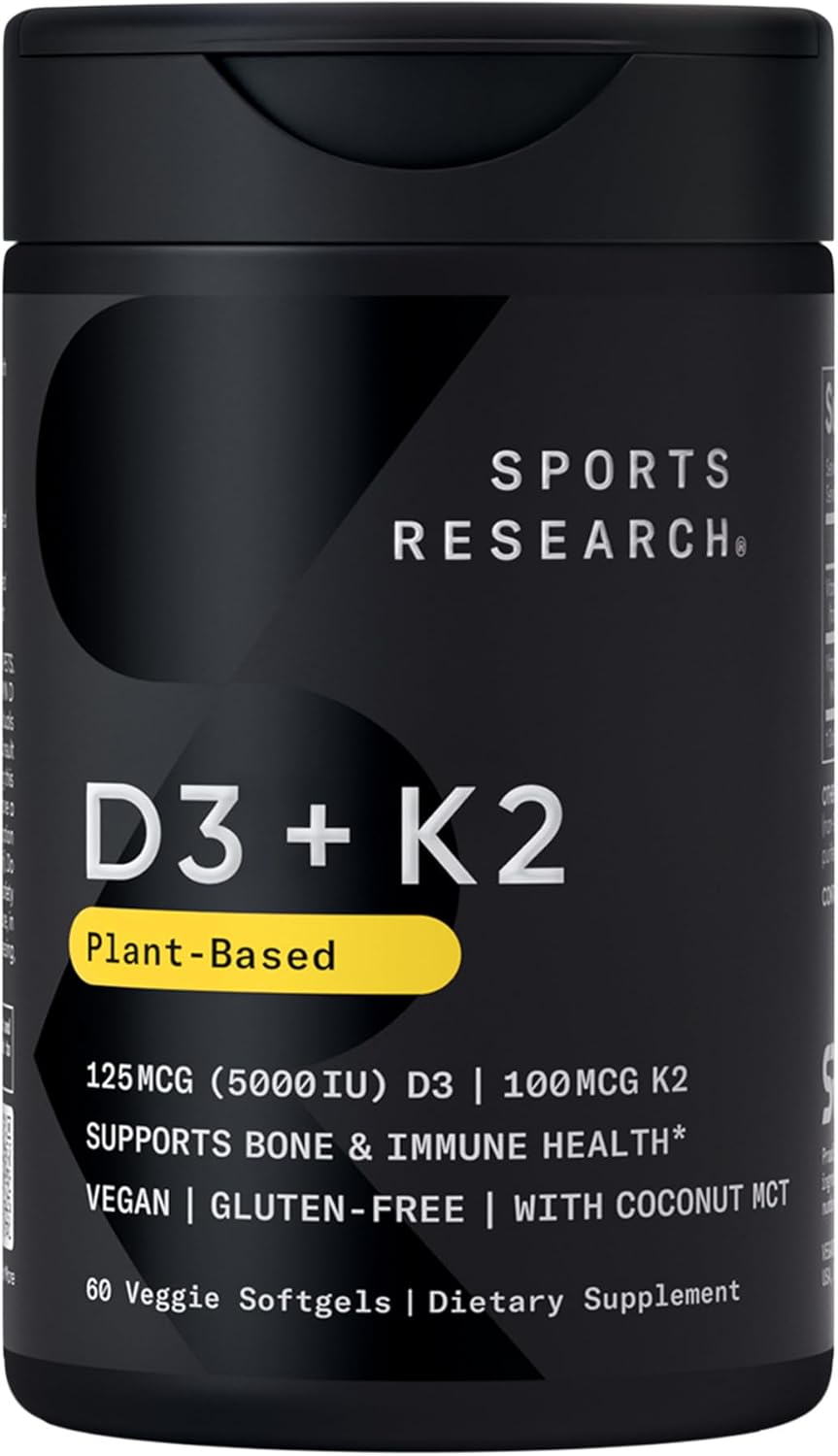
Sports Research Vitamin D3 5000 IU (mini softgel)
The best-value pick. 5000 IU D3 in a small coconut-oil softgel at the lowest cost — ideal for GLP-1 users who can layer K2 separately or get it from diet.
- No K2 co-factor
- Not NSF certified (IGEN Non-GMO is the highest cert here)
- Soft gel is gelatin-based — not vegan-friendly
Affiliate link: If you buy through this link, we may earn a commission at no extra cost to you.
Buy Sports Research Vitamin D3 5000 IU (mini softgel)
Pure Encapsulations Vitamin D3 & K2
The D3+K2 pairing pick. 5000 IU D3 + 90 mcg K2 MK-7 in one capsule — the calcium-routing rationale in a single product.
- K2 at 90 mcg is below the 180 mcg Knapen RCT dose
- Per-serving cost is mid-range
- Users on warfarin need clinician sign-off
Affiliate link: If you buy through this link, we may earn a commission at no extra cost to you.
Buy Pure Encapsulations Vitamin D3 & K2
Thorne Vitamin D-5000 (D3 5000 IU)
The highest-certification pick. NSF Certified for Sport, MCT-carrier D3 from the gold-standard practitioner brand — premium for users who prioritize cert level.
- No K2 — requires separate K2 supplement
- Higher cost vs Sports Research
- D3 only — users must actively manage K2 pairing
Affiliate link: If you buy through this link, we may earn a commission at no extra cost to you.
Buy Thorne Vitamin D-5000 (D3 5000 IU)Compare supplements with the same checklist we use.
Get the anti-aging supplement cheat sheet with evidence prompts, safety checks, and label-quality questions before you buy.
Comparison Table
| Category | #1 Sports Research Vitamin D3 5000 IU (mini softgel) Sports Research | #2 Pure Encapsulations Vitamin D3 & K2 Pure Encapsulations | #3 Thorne Vitamin D-5000 (D3 5000 IU) Thorne |
|---|---|---|---|
| Score | 8.6/10 | 8.4/10 | 8.3/10 |
| Best For | GLP-1 users who want a high-dose D3 at the best value and are comfortable managing K2 separately or via diet | GLP-1 users who want D3 plus K2 in one capsule with NSF certification | GLP-1 users who want the highest-certification D3 and are comfortable managing K2 separately |
| Pros |
|
|
|
| Cons |
|
|
|
What to Know About Vitamin D3 for GLP-1 Bone Density Preservation
Weight loss is metabolically expensive in a way most users never see. While the scale and the mirror reward the user with visible progress, the skeleton is quietly recalibrating to carry less load — and that recalibration costs bone. Across non-pharmacological weight loss interventions, approximately 1–3% of bone mineral density is lost per 10% of body weight reduction, with the loss concentrated at the hip and lumbar spine. The mechanism is partly mechanical (less mechanical loading) and partly nutritional (caloric deficits often run protein- and micronutrient-low). GLP-1 receptor agonists — semaglutide, tirzepatide, liraglutide — produce the kind of rapid, large-magnitude weight loss where this concern matters most. Two recent meta-analyses focused specifically on GLP-1 therapy and bone mineral density (Kim et al. 2024, PMID 39311048; Tan et al. 2025, PMID 39985672) have begun to characterize the signal in this cohort. The picture is not catastrophic but it is real — and for post-menopausal women already at elevated osteoporosis risk, men over 50, or anyone with a personal or family fragility-fracture history, it is a picture worth taking seriously while the weight is coming off rather than after the first fracture. Vitamin D3 sits alongside calcium and resistance training as the standard preservation protocol. The case for D3 specifically is that adequate 25-hydroxyvitamin D (25(OH)D) status is required for efficient intestinal calcium absorption, and that vitamin D and calcium combined have meta-analytic evidence of fracture-risk reduction in postmenopausal populations (Liu et al. 2020, PMID 33237064; Yao et al. 2019, PMID 31860103). None of these trials specifically enrolled GLP-1 users, but the mechanism case is clean: if rapid weight loss accelerates bone resorption, ensuring vitamin D and calcium status are not the bottleneck is a sensible adjunct. This page ranks three vitamin D3 products — Sports Research D3 5000 IU, Pure Encapsulations D3+K2, and Thorne D-5000 — for GLP-1 users prioritizing bone preservation during active weight loss. Research suggests vitamin D3 may support bone mineral density and reduce fracture risk when combined with calcium, resistance training, and adequate protein. No product on this page is a treatment for osteoporosis or any GLP-1 side effect; that distinction matters and we will be precise about it throughout.
This content is for educational purposes only and is not medical advice. These statements have not been evaluated by the FDA. This product is not intended to diagnose, treat, cure, or prevent any disease.
Key Benefits of Vitamin D3 for GLP-1 Bone Density Preservation
Supports intestinal calcium absorption — research suggests adequate 25(OH)D status is required for efficient calcium uptake, the upstream lever for bone mineralization
May support bone mineral density and reduce fracture risk when combined with calcium in postmenopausal populations — per the 2020 Liu meta-analysis (PMID 33237064) and 2019 Yao JAMA Network Open meta-analysis (PMID 31860103)
Mechanistically positioned alongside resistance training and adequate protein as the standard preservation protocol during the active GLP-1 weight-loss phase
Well-tolerated at 2000–5000 IU/day in published trials; toxicity is uncommon below 10,000 IU/day in healthy adults but requires monitoring with prolonged high-dose use
How Vitamin D3 Supports GLP-1 Bone Density Preservation
Vitamin D3 (cholecalciferol) is a fat-soluble vitamin and a precursor to the steroid hormone calcitriol (1,25-dihydroxyvitamin D). Cholecalciferol is hydroxylated in the liver to 25(OH)D (the form measured on standard labs), then again in the kidney to the active hormone calcitriol. Calcitriol's primary action is to up-regulate intestinal calcium absorption — the bottleneck for bone mineralization. In the GLP-1 bone-preservation context, three mechanisms matter. First, adequate calcium absorption requires adequate 25(OH)D status; supplementing D3 in someone with suboptimal 25(OH)D (below ~30 ng/mL by most laboratory thresholds) is the upstream lever for getting more dietary calcium into the bone-mineralization pool. Second, vitamin D and calcium together have meta-analytic evidence of fracture-risk reduction in postmenopausal populations, the demographic most overlapping with GLP-1 users. Third, vitamin D receptors are expressed in osteoblasts and osteoclasts, and adequate vitamin D status is associated with healthier bone remodeling balance — though the trial evidence for vitamin D monotherapy on BMD is more modest than the combination evidence. The D3+K2 conversation deserves precision. Vitamin K2 (MK-7) activates osteocalcin, a protein that helps direct calcium into bone matrix rather than soft tissue. The mechanism is clean. The clinical evidence base for K2 specifically on fracture outcomes is more limited than the D3+calcium evidence, but the rationale is reasonable, especially in a cohort already supplementing D3 at the higher end of the range. This is distinct from the established-osteoporosis treatment conversation. For T-scores ≤ -2.5, the standard of care includes bisphosphonates, denosumab, or anabolic agents — vitamin D3 is a foundational layer, not the active intervention. For the GLP-1 preservation context, vitamin D3 sits much closer to the primary intervention because the goal is preserving rather than rebuilding BMD.
What to Look For When Buying Vitamin D3
The most important shopping decision for the GLP-1 bone-density context is not which D3 brand you buy — it is whether you have a recent 25(OH)D level and whether the rest of the preservation protocol (calcium intake, resistance training, adequate protein) is in place. Vitamin D3 is the upstream micronutrient lever, but it does not work in isolation. Get a baseline 25(OH)D level if you have not had one in the past year. Most labs report a 'sufficient' threshold of 30 ng/mL; the literature on bone outcomes generally supports targeting 30–50 ng/mL. Below 20 ng/mL is deficient and warrants more aggressive repletion (often 50,000 IU weekly under clinical supervision). Between 20 and 30 ng/mL is the insufficient range where 4000–5000 IU/day for 8–12 weeks then reassessment is a reasonable empirical approach. Above 30 ng/mL, 1000–2000 IU/day maintenance is typical. The D3+K2 question deserves precision. K2 MK-7 has a mechanistic case for directing calcium into bone, and the D3+K2 pairing makes the supplement story cleaner. But K2's clinical evidence base for fracture outcomes is more limited than D3+calcium. If you eat leafy greens, hard cheeses, and fermented foods regularly, your dietary K2 may already be adequate. If your diet runs low on these, the Pure Encapsulations D3+K2 pairing is a reasonable single-capsule choice. If you take warfarin or another vitamin K-sensitive anticoagulant, do not add K2 without your prescribing clinician's input. Think about the stack, not the single bottle. For GLP-1 bone preservation specifically, the highest-leverage interventions are: hit calcium intake at 1000–1200 mg/day (food first — dairy, leafy greens, fortified plant milks); do at least two resistance-training sessions per week (mechanical loading is the strongest signal for bone retention); hit total protein at 1.6–2.2 g/kg body weight (the muscle-bone axis is real); ensure 25(OH)D is in the 30–50 ng/mL range; and have the GLP-1 dose-rate conversation with your prescribing clinician if weight loss is exceeding 1% body weight per week sustained. Food-first note: vitamin D3 supplementation does not replace dietary calcium, resistance training, or adequate protein — the three actual drivers of bone preservation during weight loss. Vitamin D3 is the micronutrient cofactor that lets the rest of the protocol work.
Dosage Guidance
Always follow your healthcare provider's recommendations. Dosages vary by individual health status, age, and goals.
Common Vitamin D3 Complaints (And How to Avoid Them)
Based on analysis of thousands of customer reviews across Vitamin D3 products.
"My doctor said my vitamin D was fine — why would I supplement?"
'Fine' often means above the laboratory cutoff (typically 20 or 30 ng/mL). The bone-outcomes literature generally supports targeting 30–50 ng/mL, and the rapid catabolic state of GLP-1 weight loss is exactly the context where running mid-range rather than just-above-threshold matters. Ask for the actual number rather than 'fine'.
"I'm worried about hypercalcemia from 5000 IU"
Hypercalcemia from 5000 IU/day in a healthy adult without hyperparathyroidism, sarcoidosis, or pre-existing hypercalcemia is uncommon and slow to develop. The reasonable safeguard is checking 25(OH)D and serum calcium at 12 weeks and every 6 months on a sustained dose. If 25(OH)D is above 50 ng/mL, dropping to 2000 IU/day is sensible.
"Pure Encapsulations is more expensive than Sports Research — is K2 worth it?"
Only if your dietary K2 is low (no leafy greens, no hard cheese, no fermented foods) and you are not on warfarin. For users with K2-rich diets, the Sports Research D3-only product at $0.20/day is a defensible choice with K2 from food.
Safety & Interactions
- Pregnancy and breastfeeding: Consult your healthcare provider before taking this supplement during pregnancy or while nursing. The safety of supplemental doses beyond dietary intake has not been established in pregnant or lactating women.
- Blood thinners: If you take blood-thinning medications (e.g., warfarin, apixaban, rivaroxaban, clopidogrel, or high-dose aspirin), consult your healthcare provider BEFORE starting this supplement, as it may have additive antiplatelet or anticoagulant effects.
- Kidney disease: If you have chronic kidney disease (CKD) or any significant kidney impairment, consult your healthcare provider before taking this supplement. Some supplements can accumulate to dangerous levels when kidney function is reduced.
- Gout: Individuals with gout should consult their healthcare provider before starting this supplement. Certain supplements (e.g., collagen, fish oil, niacin) may affect uric acid levels or trigger flares in susceptible individuals.
- Important: This supplement is not a replacement for prescription medications. It is supportive for individuals with low baseline status, not a treatment for diagnosed conditions (anxiety disorders, insomnia, hypertension, osteoporosis, etc.). Do not stop or reduce any prescription without consulting your doctor.
""What I would emphasize for GLP-1 users concerned about bone density: vitamin D3 is the micronutrient cofactor that lets calcium absorption work — but the bone-preservation conversation during rapid weight loss is dominated by mechanical loading and total nutrition, not a single vitamin. Two resistance-training sessions per week, 1000–1200 mg/day calcium (food first), 1.6–2.2 g/kg protein, and adequate 25(OH)D status are the four levers. Layer D3 on top of corrected basics rather than expecting it to do the work alone. For post-menopausal women on GLP-1 therapy — the highest-risk subset — a baseline DEXA and serial 25(OH)D measurement is a reasonable conversation with the prescribing clinician."
— Angelique Nicole R. Villegas, RND, Registered Nutritionist Dietitian · PRC Philippines · License #0023950
Frequently Asked Questions
Citations & Research
This page references peer-reviewed research indexed on PubMed/NCBI. Citations are provided for transparency. Always consult a qualified healthcare professional before making any medical decisions.
- [1]Liu C, Kuang X, Li K et al. “Effects of combined calcium and vitamin D supplementation on osteoporosis in postmenopausal women: a systematic review and meta-analysis of randomized controlled trials.” Food & Function, 2020. PMID 33237064 ↗
- [2]Yao P, Bennett D, Mafham M et al. “Vitamin D and Calcium for the Prevention of Fracture: A Systematic Review and Meta-analysis.” JAMA Network Open, 2019. PMID 31860103 ↗
- [3]Kim HJ, Choi SA, Gu MS et al. “Effects of Glucagon-Like Peptide-1 Receptor Agonist on Bone Mineral Density and Bone Turnover Markers: A Meta-Analysis.” Diabetes/Metabolism Research and Reviews, 2024. PMID 39311048 ↗
- [4]Tan Y, Liu S, Tang Q et al. “Effect of GLP-1 receptor agonists on bone mineral density, bone metabolism markers, and fracture risk in type 2 diabetes: a systematic review and meta-analysis.” Acta Diabetologica, 2025. PMID 39985672 ↗
Ready to Try Vitamin D3?
Our top pick for glp-1 bone density preservation. Third-party tested, highly reviewed.
Affiliate link: If you buy through this link, we may earn a commission at no extra cost to you.
Shop #1 Pick — Sports Research Vitamin D3 5000 IU (mini softgel)Continue exploring
- everything we know about Vitamin D3Supplement overview
- see all glp 1 bone density preservation supplements we coverGoal overview
- see our Vitamin D3 picks for blood pressure supportSame supplement, different goal
- Vitamin D3 research for bone healthEditor pick
- clinical notes on Vitamin D3 and osteoporosisEditor pick
- Creatine for glp 1 muscle loss preventionEditor pick
- where Magnesium fits for glp 1 sleep supportEditor pick
Get the evidence-graded supplement cheat sheet.
Evidence prompts, safety checks, and label-quality questions before you buy — free, straight to your inbox.
No spam. Unsubscribe anytime.