
Rhodiola Rosea for Menopause Fatigue: The Adaptogen Angle
Rhodiola rosea for perimenopausal fatigue and HPA-axis exhaustion in women 42-55. Evidence-based picks with YMYL safety notes.

This content is for educational purposes only and is not medical advice. These statements have not been evaluated by the FDA. This product is not intended to diagnose, treat, cure, or prevent any disease. Always consult your healthcare provider before starting any supplement.
Best Rhodiola Rosea for Menopause Fatigue in 2026
Ranked by quality, value, and clinical backing
Where available, we show when each product price was last checked so the list stays honest without overreacting to normal Amazon price movement.

NOW Foods Rhodiola 500mg
The best-value pick with the correct dual standardization (3% rosavins + 1% salidroside) matching the SHR-5 marker profile used in most RCTs.
- Contains stearic acid and silica excipients
- Not NSF certified
- 500mg is on the higher end of the studied range
Affiliate link: If you buy through this link, we may earn a commission at no extra cost to you.
Buy NOW Foods Rhodiola 500mg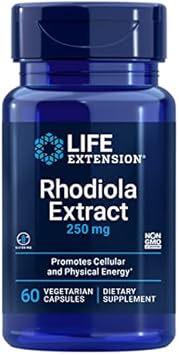
Life Extension Rhodiola Extract
The conservative-titration pick. 250mg per capsule lets you start low and assess tolerance before stepping up to 500mg.
- Standardized to rosavins only — no salidroside marker number
- Two capsules required to reach 500mg studied dose
- Higher per-mg cost than NOW Foods
Affiliate link: If you buy through this link, we may earn a commission at no extra cost to you.
Buy Life Extension Rhodiola Extract
Gaia Herbs Rhodiola Rosea
The full-spectrum pick. Phyto-cap format preserves a wider constituent profile beyond the standard rosavin/salidroside marker pair.
- Phytosome format makes trial-extract comparison difficult
- Highest per-serving cost
- Marker-compound numbers not directly comparable
Affiliate link: If you buy through this link, we may earn a commission at no extra cost to you.
Buy Gaia Herbs Rhodiola RoseaCompare supplements with the same checklist we use.
Get the anti-aging supplement cheat sheet with evidence prompts, safety checks, and label-quality questions before you buy.
Comparison Table
| Category | #1 NOW Foods Rhodiola 500mg NOW Foods | #2 Life Extension Rhodiola Extract Life Extension | #3 Gaia Herbs Rhodiola Rosea Gaia Herbs |
|---|---|---|---|
| Score | 8.7/10 | 8.3/10 | 7.9/10 |
| Best For | Cost-conscious perimenopausal women on an 8-week trial | Women who prefer a slow titration from a longevity-brand source | Women who prefer full-spectrum herbal formats over standardized extracts |
| Pros |
|
|
|
| Cons |
|
|
|
What to Know About Rhodiola Rosea for Menopause Fatigue
Perimenopausal fatigue rarely reads like ordinary tiredness. Many women between 42 and 55 describe a wired-tired pattern: enough cortisol to feel keyed up but not enough recovery capacity to actually do the day. The afternoon crash hits earlier and lasts longer. Caffeine works less well, then works worse, then makes the wired-tired pattern louder. Sleep doesn't repair the fatigue the way it used to. This is not a clinical diagnosis but it is a recognizable cluster, and it sits at the intersection of HPA-axis stress physiology and the hormonal transition. Rhodiola rosea is the adaptogen with the most consistent Western RCT evidence base for stress-related fatigue. The Panossian 2009 review (PMID 19500070) in Current Clinical Pharmacology synthesizes adaptogen evidence in fatigue, including SHR-5 standardized extract trials showing improvements over four weeks. The Edwards 2012 open-label study (PMID 22228617) of WS 1375 extract in subjects with life-stress symptoms reported similar gains across fatigue, work performance, and quality-of-life endpoints. Neither trial enrolled perimenopausal women as the specific population — that is an honest limitation we'll flag throughout — but the fatigue phenotype studied in those trials overlaps meaningfully with what many perimenopausal women describe. This page ranks three rhodiola products — NOW Foods, Life Extension, and Gaia Herbs — for women in the broader peri-fatigue window. Research suggests rhodiola may support stress-related fatigue and HPA-axis resilience over 4-8 weeks of consistent use. No product on this page is a treatment for perimenopause, depression, or any specific disease; that distinction matters and we'll be precise about it throughout.
This content is for educational purposes only and is not medical advice. These statements have not been evaluated by the FDA. This product is not intended to diagnose, treat, cure, or prevent any disease.
Key Benefits of Rhodiola Rosea for Menopause Fatigue
Research suggests rhodiola may reduce stress-related fatigue and improve attention over 4 weeks at standardized doses — based on the Panossian 2009 adaptogen evidence review (PMID 19500070) synthesizing SHR-5 trial data
May support HPA-axis resilience as measured by salivary cortisol response to wakening — mechanism work supports an adaptogen framing rather than a stimulant framing
Generally well-tolerated in published trials at 200-680mg/day standardized extract; most reported side effects are mild and reversible (jitteriness, dry mouth, mild insomnia if dosed late)
How Rhodiola Rosea Supports Menopause Fatigue
Rhodiola rosea extracts contain rosavins (rosavin, rosin, rosarin), salidroside (the principal phenylpropanoid), and a broader spectrum of phenolic and flavonoid constituents. The modern mechanistic consensus frames rhodiola as a stress-system modulator rather than a direct stimulant. Preclinical work points to effects on the HPA axis (modulating cortisol response to stressors), monoaminergic neurotransmission (serotonin, dopamine, noradrenaline), and AMPK / cellular energy signaling pathways. The clinical translation is consistent: rhodiola tends to flatten the cortisol-stress response and lift the wired-tired ceiling rather than acting like a caffeine-style stimulant. This distinction matters for the peri-fatigue cluster specifically. Many perimenopausal women find caffeine is becoming counterproductive — the wired-tired pattern intensifies, sleep degrades, and afternoon crashes worsen. An adaptogen that modulates the stress response without adding stimulant burden is mechanistically a better fit than escalating caffeine. The evidence for this fit is not perimenopause-specific but it is mechanism-coherent.
What to Look For When Buying Rhodiola Rosea
The single most important decision in rhodiola shopping for the peri-fatigue cluster is not which brand you buy — it's whether you can stick with the protocol for at least 4 weeks before judging. The Olsson 2009 trial assessed at 4 weeks. The Edwards 2012 study ran 12. Effects emerge within days for some users but should not be judged until the 4-week mark. Dose translation is cleaner than for many botanicals. The strongest trials used 200-680mg/day of standardized extract. NOW Foods at 500mg/day sits in the middle of that range with dual standardization (3% rosavins + 1% salidroside) that matches the SHR-5 marker profile in the cited RCTs. Life Extension at 250mg lets you start lower and titrate — useful if you are sensitive to activating supplements. Gaia's phyto-cap format is a different category; comparison to the trial extracts is not direct. Timing matters. Rhodiola is mildly activating in most users — take it in the morning or early afternoon, not within six hours of bed. Late dosing is the most common cause of "rhodiola gave me insomnia" complaints in the forums. Think about the stack, not the single bottle. For peri-fatigue specifically, rhodiola works alongside — not instead of — the basics: regular exercise, magnesium glycinate, sleep regularization, addressing thyroid (TSH, free T4, free T3), ferritin, B12, and vitamin D. Many women find that correcting a missing basic (ferritin under 50, vitamin D under 30) does more for fatigue than any single adaptogen. Food-first note: supplementing rhodiola does not replace addressing thyroid, iron, or vitamin D deficiencies that often co-present with perimenopausal fatigue. Get the basic labs (CBC, ferritin, TSH, free T4, free T3, vitamin D, B12) before assuming an adaptogen is the answer.
Dosage Guidance
Always follow your healthcare provider's recommendations. Dosages vary by individual health status, age, and goals.
Common Rhodiola Rosea Complaints (And How to Avoid Them)
Based on analysis of thousands of customer reviews across Rhodiola Rosea products.
"I've taken rhodiola for 2 weeks and nothing's changed"
Two weeks is below the minimum useful trial duration. The SHR-5 trial data synthesized in Panossian 2009 (PMID 19500070) used 4-week assessment windows. Hold the dose, keep a daily symptom diary, and reassess at 4 weeks.
"Rhodiola made me feel jittery and disrupted my sleep"
Both are dose-and-timing issues. Take rhodiola only in the morning — never within six hours of bedtime. If morning jitteriness persists, drop to half the starting dose or switch to Life Extension 250mg as a lower-floor titration option.
"Life Extension is more expensive per mg than NOW Foods — is it worth it?"
Only if you specifically want the conservative-titration path or prefer the direct-brand sourcing. For most women on a 4-8 week trial, NOW Foods at full dual standardization at the lowest per-serving cost is a defensible primary choice with comparable expected effect.
Safety & Interactions
- Pregnancy and breastfeeding: Consult your healthcare provider before taking this supplement during pregnancy or while nursing. The safety of supplemental doses beyond dietary intake has not been established in pregnant or lactating women.
- Blood thinners: If you take blood-thinning medications (e.g., warfarin, apixaban, rivaroxaban, clopidogrel, or high-dose aspirin), consult your healthcare provider BEFORE starting this supplement, as it may have additive antiplatelet or anticoagulant effects.
- Kidney disease: If you have chronic kidney disease (CKD) or any significant kidney impairment, consult your healthcare provider before taking this supplement. Some supplements can accumulate to dangerous levels when kidney function is reduced.
- Gout: Individuals with gout should consult their healthcare provider before starting this supplement. Certain supplements (e.g., collagen, fish oil, niacin) may affect uric acid levels or trigger flares in susceptible individuals.
- Important: This supplement is not a replacement for prescription medications. It is supportive for individuals with low baseline status, not a treatment for diagnosed conditions (anxiety disorders, insomnia, hypertension, osteoporosis, etc.). Do not stop or reduce any prescription without consulting your doctor.
""What I'd emphasize for women in this window: rhodiola has reasonable evidence for the stress-fatigue cluster and the mechanism (HPA-axis modulation, monoaminergic effects) is mechanistically coherent with the wired-tired peri-fatigue pattern. But no rhodiola RCT has enrolled perimenopausal women specifically — that generalization is reasoned, not direct evidence. Layer rhodiola on top of corrected basics (exercise, sleep, magnesium, thyroid and iron labs checked) rather than expecting it to do the heavy lifting alone. Take it in the morning; never within six hours of bed."
— Angelique Nicole R. Villegas, RND, Registered Nutritionist Dietitian · PRC Philippines · License #0023950
Frequently Asked Questions
Citations & Research
This page references peer-reviewed research indexed on PubMed/NCBI. Citations are provided for transparency. Always consult a qualified healthcare professional before making any medical decisions.
- [1]Panossian A, Wikman G. “Evidence-based efficacy of adaptogens in fatigue, and molecular mechanisms related to their stress-protective activity.” Current Clinical Pharmacology, 2009. PMID 19500070 ↗
- [2]Edwards D, Heufelder A, Zimmermann A. “Therapeutic effects and safety of Rhodiola rosea extract WS® 1375 in subjects with life-stress symptoms — results of an open-label study.” Phytotherapy Research, 2012. 101. doi:10.1002/ptr.3712PMID 22228617 ↗
- [3]Mao JJ, Xie SX, Zee J et al. “Rhodiola rosea versus sertraline for major depressive disorder: A randomized placebo-controlled trial.” Phytomedicine, 2015. 57. doi:10.1016/j.phymed.2015.01.010PMID 25837277 ↗
- [4]Mao JJ, Li QS, Soeller I et al. “Rhodiola rosea therapy for major depressive disorder: a study protocol for a randomized, double-blind, placebo-controlled trial.” Journal of Clinical Trials, 2014. 57. PMID 25610752 ↗
Ready to Try Rhodiola Rosea?
Our top pick for menopause fatigue. Third-party tested, highly reviewed.
Affiliate link: If you buy through this link, we may earn a commission at no extra cost to you.
Shop #1 Pick — NOW Foods Rhodiola 500mgContinue exploring
- everything we know about Rhodiola RoseaSupplement overview
- see all menopause fatigue supplements we coverGoal overview
- our Rhodiola Rosea review for burnout supportSame supplement, different goal
- the Rhodiola Rosea page for stress resilienceEditor pick
- see Rhodiola Rosea evidence for stress supportEditor pick
- Ashwagandha options for perimenopause supportEditor pick
- how Maca supports perimenopause supportEditor pick
Get the evidence-graded supplement cheat sheet.
Evidence prompts, safety checks, and label-quality questions before you buy — free, straight to your inbox.
No spam. Unsubscribe anytime.