
Best Policosanol for Cholesterol Management (2026 Review)
Compare the best policosanol supplements for cholesterol management in 2026. Evidence-based rankings, dosage guidance, and honest safety notes from our

This content is for educational purposes only and is not medical advice. These statements have not been evaluated by the FDA. This product is not intended to diagnose, treat, cure, or prevent any disease. Always consult your healthcare provider before starting any supplement.
Best Policosanol for Cholesterol Management in 2026
Ranked by quality, value, and clinical backing
Where available, we show when each product price was last checked so the list stays honest without overreacting to normal Amazon price movement.

NOW Foods Policosanol 10mg
NOW Foods Policosanol 10mg. 4.6★ (2,100 ratings). Confirmed in stock.
- Amazon price and availability can change over time
Affiliate link: If you buy through this link, we may earn a commission at no extra cost to you.
Buy NOW Foods Policosanol 10mg
Swanson Ultra Policosanol 10mg
Swanson Ultra Policosanol 10mg. 4.5★ (1,800 ratings). Confirmed in stock.
- Amazon price and availability can change over time
Affiliate link: If you buy through this link, we may earn a commission at no extra cost to you.
Buy Swanson Ultra Policosanol 10mg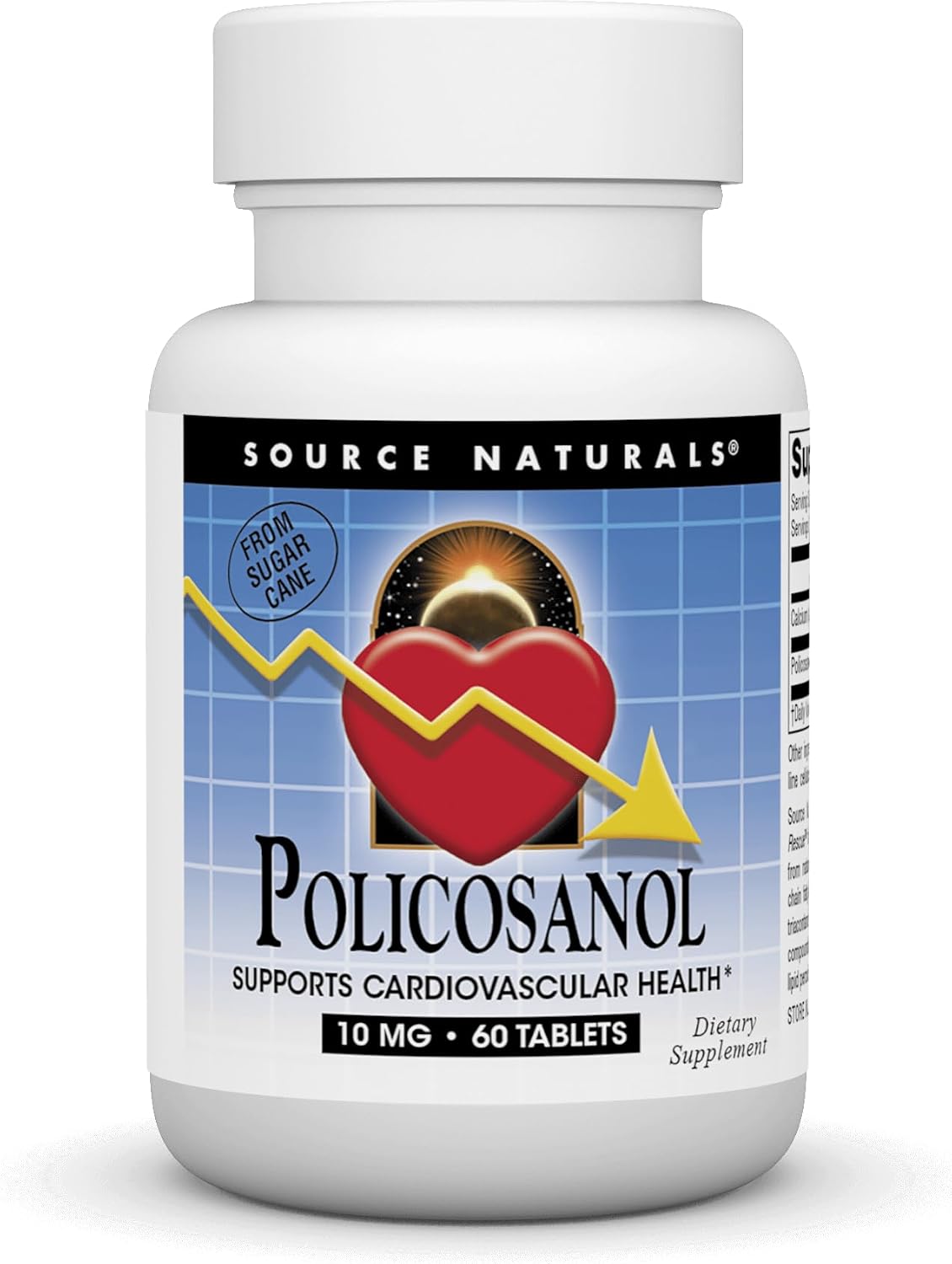
Source Naturals Policosanol 10mg, 60 Tablets
Source Naturals Policosanol 10mg, 60 Tablets. 4.8★ (9 ratings). Confirmed in stock.
- Lower price may reflect a smaller count or serving size — check the label
- Smaller customer-review base than category best-sellers
Affiliate link: If you buy through this link, we may earn a commission at no extra cost to you.
Buy Source Naturals Policosanol 10mg, 60 TabletsCompare supplements with the same checklist we use.
Get the anti-aging supplement cheat sheet with evidence prompts, safety checks, and label-quality questions before you buy.
Comparison Table
| Category | #1 NOW Foods Policosanol 10mg NOW Foods | #2 Swanson Ultra Policosanol 10mg Swanson | #3 Source Naturals Policosanol 10mg, 60 Tablets Source Naturals |
|---|---|---|---|
| Score | 8.8/10 | 8.6/10 | 9.2/10 |
| Best For | |||
| Pros |
|
|
|
| Cons |
|
|
|
What to Know About Policosanol for Cholesterol Management
Policosanol sits in an interesting corner of the supplement world — genuinely popular, modestly priced, and surrounded by a scientific debate that most product pages quietly ignore. It's a mixture of long-chain alcohols extracted primarily from sugar cane wax, and it's been marketed for decades as a natural approach to supporting healthy cholesterol levels. The early Cuban clinical trials were striking. The independent replications, particularly from European researchers, were not. That gap matters, and we'll explain exactly why. This review covers three of the most accessible 10mg policosanol supplements available in 2026: Swanson Ultra, NOW Foods, and Doctor's Best. All three hit the dose range used in clinical research. None are wildly expensive. But there are meaningful differences in manufacturing credentials, sourcing transparency, and value — and there's one critical caveat about source origin that applies to all of them. We're not here to oversell this ingredient. Policosanol may be worth considering as part of a broader cardiovascular wellness strategy, but only with realistic expectations and a conversation with your healthcare provider. What follows is the most honest, evidence-grounded breakdown of these products we can offer.
This content is for educational purposes only and is not medical advice. These statements have not been evaluated by the FDA. This product is not intended to diagnose, treat, cure, or prevent any disease.
Key Benefits of Policosanol for Cholesterol Management
May support healthy platelet function, with some human studies suggesting effects on platelet aggregation at standard doses
Well-tolerated in clinical trials with a low reported side-effect profile across multiple study populations
Accessible price point makes it a low-cost addition to a broader cardiovascular wellness supplement stack when used with professional guidance
How Policosanol Supports Cholesterol Management
Policosanol is a mixture of aliphatic primary alcohols derived from plant waxes — most commonly sugar cane, but also beeswax, wheat germ, and rice bran. The primary alcohol of interest is octacosanol, typically comprising 60–70% of the mixture. The proposed mechanism for cholesterol modulation involves inhibition of hepatic cholesterol synthesis, potentially upstream of the HMG-CoA reductase pathway that statins target, though the precise biochemical pathway remains debated in the literature. Separately, there's more consistent human evidence for policosanol's effects on platelet aggregation — specifically, reducing the tendency of platelets to clump, which may have relevance to cardiovascular health independent of lipid levels. Some researchers have also proposed antioxidant activity as a contributing mechanism. None of these mechanisms are fully elucidated in human trials, and it's worth noting that the specific octacosanol-to-other-alcohol ratio in the source material likely influences biological activity — which is why geographic source matters more than the label claim alone.
What to Look For When Buying Policosanol
The single most important thing to understand when buying policosanol is the source-origin question. Early clinical trials showing LDL reductions were conducted using Cuban sugar cane-derived policosanol, produced by a specific Cuban pharmaceutical manufacturer. When independent researchers tested commercially available policosanol — including products made from sugar cane grown elsewhere — they repeatedly failed to replicate those lipid results. This doesn't mean commercial policosanol is worthless, but it does mean the LDL-lowering claim rests on shaky ground for anything not verified as Cuban-sourced. Dose standardization is your next checkpoint. Stick to 10mg products. The clinical literature clustered around 5–20mg daily, with 10mg being the most common trial dose. There's no evidence that 20mg or 40mg products outperform 10mg — and given the conflicted evidence base, paying more for a higher dose doesn't make pharmacological sense with current data. Manufacturing standards matter considerably in this category. GMP certification is a baseline — it tells you the product contains what it claims and isn't contaminated. Third-party testing (NSF, USP, Informed Sport) goes a step further by providing independent verification. NOW Foods and Doctor's Best both offer third-party credentialing; Swanson relies on its own GMP infrastructure. None of these are red flags — but if you have specific purity concerns, the third-party-tested options provide additional assurance. Finally, think about form factor. Capsules dissolve more predictably than tablets for most people. Doctor's Best uses a tablet that reportedly has a good dissolution profile, but if you've had absorption issues with supplements in tablet form in the past, capsules from NOW or Swanson are the safer bet. Price differences across these three products are minimal in absolute terms — we're talking about a few dollars per bottle — so let quality credentials and format preference drive your decision more than price alone.
Dosage Guidance
Always follow your healthcare provider's recommendations. Dosages vary by individual health status, age, and goals.
Common Policosanol Complaints (And How to Avoid Them)
Based on analysis of thousands of customer reviews across Policosanol products.
"I've been taking it for months and my cholesterol hasn't changed at all"
This is consistent with what independent research shows — non-Cuban commercial policosanol hasn't reliably demonstrated LDL-lowering effects in rigorous Western trials. We flag this prominently in our evidence section rather than burying it. If cholesterol reduction is your primary goal, your provider may recommend alternatives with stronger independent evidence.
"Can't find any that specify Cuban origin — how do I know which to trust?"
You're asking the right question, and the honest answer is that most U.S. commercial products don't specify Cuban origin on the label. We've flagged this caveat for all three reviewed products. Until more sourcing transparency becomes standard in this category, consumers can't definitively verify geographic origin without contacting the manufacturer directly.
"It upsets my stomach when I take it on an empty stomach"
This is a common tolerability pattern with fat-soluble compounds like policosanol. Taking it with a meal — ideally one containing some dietary fat — can significantly reduce GI discomfort and may also support absorption. All three products on this list are suitable for with-food dosing.
Safety & Interactions
- Pregnancy and breastfeeding: Consult your healthcare provider before taking this supplement during pregnancy or while nursing. The safety of supplemental doses beyond dietary intake has not been established in pregnant or lactating women.
- Blood thinners: If you take blood-thinning medications (e.g., warfarin, apixaban, rivaroxaban, clopidogrel, or high-dose aspirin), consult your healthcare provider BEFORE starting this supplement, as it may have additive antiplatelet or anticoagulant effects.
- Kidney disease: If you have chronic kidney disease (CKD) or any significant kidney impairment, consult your healthcare provider before taking this supplement. Some supplements can accumulate to dangerous levels when kidney function is reduced.
- Gout: Individuals with gout should consult their healthcare provider before starting this supplement. Certain supplements (e.g., collagen, fish oil, niacin) may affect uric acid levels or trigger flares in susceptible individuals.
""As a registered dietitian, I want to be clear: policosanol should never be used as a first-line substitute for evidence-based lifestyle changes — Mediterranean-style eating patterns and regular aerobic exercise still have far stronger cardiovascular support data. If you're considering policosanol as a complement to those foundations, keep expectations realistic and bring your lipid panel results to every follow-up appointment."
Frequently Asked Questions
Citations & Research
This page references peer-reviewed research indexed on PubMed/NCBI. Citations are provided for transparency. Always consult a qualified healthcare professional before making any medical decisions.
- [1]Backes JM, Gibson CA, Ruisinger JF et al. “Modified-policosanol does not reduce plasma lipoproteins in hyperlipidemic patients when used alone or in combination with statin therapy.” Lipids, 2011. doi:10.1007/s11745-011-3591-8PMID 21739240 ↗
- [c2]Castaño G, Más R, Fernández JC et al. “Effects of policosanol on older patients with hypertension and type II hypercholesterolaemia.” Drugs in R&D, 2002. Clinical study. PMID 12099160 ↗
- [c3]Cubeddu LX, Cubeddu RJ, Heimowitz T et al. “Comparative lipid-lowering effects of policosanol and atorvastatin: a randomized, parallel, double-blind, placebo-controlled trial.” American heart journal, 2006. Randomized trial. PMID 17070175 ↗
- [c4]Dulin MF, Hatcher LF, Sasser HC et al. “Policosanol is ineffective in the treatment of hypercholesterolemia: a randomized controlled trial.” The American journal of clinical nutrition, 2006. Randomized trial. PMID 17158441 ↗
Ready to Try Policosanol?
Our top pick for cholesterol management. Third-party tested, highly reviewed.
Affiliate link: If you buy through this link, we may earn a commission at no extra cost to you.
Shop #1 Pick — NOW Foods Policosanol 10mgContinue exploring
- Policosanol — our editorial overviewSupplement overview
- top-rated cholesterol support supplementsGoal overview
- Fish Oil evidence for cholesterol supportAlternative supplement
- the Phytosterols page for cholesterol supportEditor pick
- Niacin for cholesterol supportEditor pick
- which form is right for youCompare options
Get the evidence-graded supplement cheat sheet.
Evidence prompts, safety checks, and label-quality questions before you buy — free, straight to your inbox.
No spam. Unsubscribe anytime.