
Maca for Perimenopause: Mood, Libido, and the Non-Estrogenic Angle
Maca for perimenopause mood, libido, and energy in women 42-55. Non-phytoestrogenic mechanism, evidence-based picks with YMYL safety notes.

This content is for educational purposes only and is not medical advice. These statements have not been evaluated by the FDA. This product is not intended to diagnose, treat, cure, or prevent any disease. Always consult your healthcare provider before starting any supplement.
Best Maca for Perimenopause Support in 2026
Ranked by quality, value, and clinical backing
Where available, we show when each product price was last checked so the list stays honest without overreacting to normal Amazon price movement.

Navitas Organics Maca Powder
The best form pick. Gelatinized maca powder (improved digestibility and starch removed), USDA Organic, and powder format allows the flexible dosing needed to approach the 3.5 g/day trial dose.
- Powder format less convenient than capsules
- Distinctive flavor (earthy, slightly bitter) — requires smoothie or warm drink integration
- Not standardized to macamides
Affiliate link: If you buy through this link, we may earn a commission at no extra cost to you.
Buy Navitas Organics Maca Powder
NOW Foods Maca 500mg
The value pick. Best per-serving price, capsule convenience, and NOW Foods label-accuracy track record. The trade-off: 500mg per cap is well below the trial dose, requiring 4–6 capsules to approach trial relevance.
- Not gelatinized
- Not standardized to macamides
- 500mg per cap is below the 1500–3500mg used in trials — requires multiple capsules
Affiliate link: If you buy through this link, we may earn a commission at no extra cost to you.
Buy NOW Foods Maca 500mg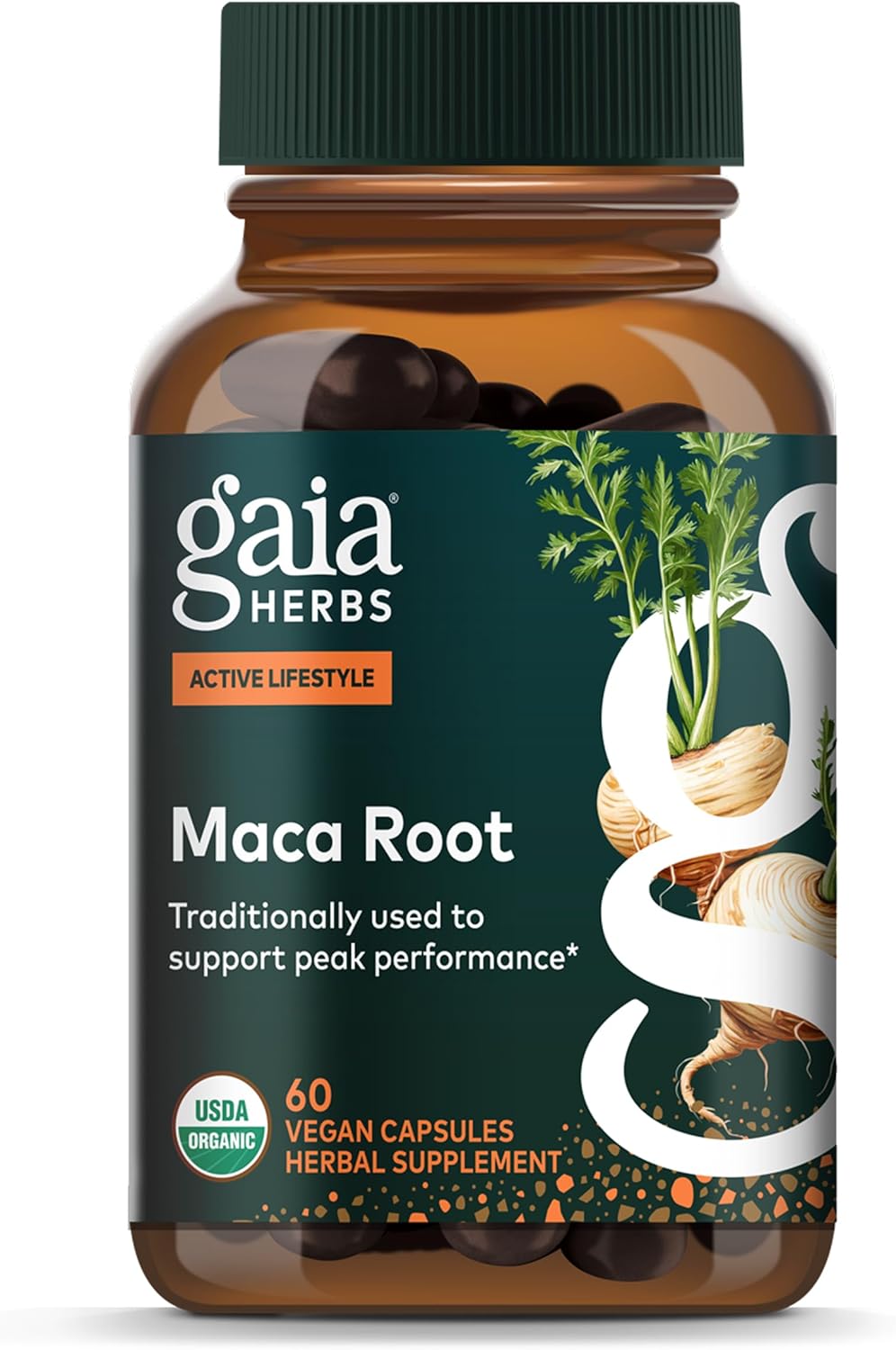
Gaia Herbs Maca Root
The higher-dose-per-serving capsule pick. Full-spectrum extract and powder blend at 1200mg per 2-capsule serving, from a brand with strong sourcing transparency.
- Highest per-serving price
- 2-capsule serving
- Not certified organic
Affiliate link: If you buy through this link, we may earn a commission at no extra cost to you.
Buy Gaia Herbs Maca RootCompare supplements with the same checklist we use.
Get the anti-aging supplement cheat sheet with evidence prompts, safety checks, and label-quality questions before you buy.
Comparison Table
| Category | #1 Navitas Organics Maca Powder Navitas Organics | #2 NOW Foods Maca 500mg NOW Foods | #3 Gaia Herbs Maca Root Gaia Herbs |
|---|---|---|---|
| Score | 8.5/10 | 7.9/10 | 8/10 |
| Best For | Women who tolerate powder formats and want the gelatinized form at trial-relevant doses | Cost-conscious starters who want capsule convenience and will run multi-cap doses | Women who want capsule convenience at a higher per-serving dose closer to the trial range |
| Pros |
|
|
|
| Cons |
|
|
|
What to Know About Maca for Perimenopause Support
Most women in their early 40s who land on a maca page have already discounted soy and red clover — either because they don't want phytoestrogens, or because they have hormone-sensitive cancer history that makes those off-limits. Maca occupies an unusual position in the menopause botanical landscape: a perennial Andean cruciferous root with a moderate RCT base for mood and libido in postmenopausal women, and — critically — a mechanism that does NOT involve estrogen-receptor binding. The most-cited human signal is Brooks et al. (2008, PMID 18784609) — a randomized double-blind placebo-controlled crossover trial in postmenopausal women showing 3.5 g/day maca for 6 weeks reduced psychological symptoms (anxiety, depression on the Greene Climacteric Scale) and sexual dysfunction measures versus placebo, with no change in estrogen or androgen levels. Lee et al. (2011, PMID 21840656) — a systematic review in Maturitas — synthesized 4 RCTs and concluded the evidence is suggestive of benefit but limited by small sample sizes and methodological heterogeneity. This page ranks three maca products — Navitas Organics powder, NOW Foods capsules, and Gaia Herbs full-spectrum — for women in the perimenopause window who want a non-phytoestrogenic option. Research suggests maca may support mood and libido in midlife women, but no product is a treatment for any perimenopause symptom. That distinction matters.
This content is for educational purposes only and is not medical advice. These statements have not been evaluated by the FDA. This product is not intended to diagnose, treat, cure, or prevent any disease.
Key Benefits of Maca for Perimenopause Support
Research suggests maca may reduce psychological symptoms (anxiety, depression) and improve sexual function in postmenopausal women at 3.5 g/day over 6 weeks — based on the most-cited RCT (Brooks 2008, PMID 18784609)
Acts via mechanisms that do NOT involve estrogen or androgen receptor binding — a critical distinction from phytoestrogenic botanicals (soy, red clover) that matters for women with hormone-sensitive cancer history
Generally well-tolerated in published trials at 1.5–3.5 g/day; most reported side effects are mild (digestive discomfort) and reversible. The gelatinized form has the better tolerability profile
How Maca Supports Perimenopause Support
Maca (Lepidium meyenii) is a cruciferous root native to the Peruvian Andes. The bioactive constituents include macamides (unique to maca), macaenes, glucosinolates, sterols, and alkaloids. The most-discussed mechanism for the mood and libido effects is modulation of the hypothalamic-pituitary axis without direct estrogen-receptor binding — Brooks 2008 (PMID 18784609) showed maca effects on Greene Climacteric Scale without changes in estradiol, FSH, or testosterone. The proposed mechanism involves macamides acting on endocannabinoid system pathways and possibly serotonergic signaling. This non-phytoestrogenic mechanism is the most important clinical distinction. Women with hormone-sensitive cancer history (breast, ovarian, uterine) are often told to avoid soy isoflavones, red clover, and pueraria mirifica — all of which have estrogen-receptor activity. Maca's mechanism is different, and the trial-level signal in postmenopausal women is encouraging, though the oncology-specific safety database in this population is incomplete. A secondary mechanism worth noting: maca is a cruciferous root and contains glucosinolates. Like other cruciferous plants (broccoli, cabbage, kale), high doses can theoretically interfere with thyroid hormone production through goitrogenic compounds. This is rarely clinically meaningful at supplement doses but is the basis for the thyroid caution in the safety section.
What to Look For When Buying Maca
The most important decision in maca shopping is gelatinized vs raw. Raw maca contains high levels of starches that can produce GI discomfort and reduce bioavailability of the macamides. Gelatinized maca has been pressure-cooked to gelatinize the starches and improve absorption — Navitas Organics discloses this explicitly. NOW Foods' raw maca capsules are fine for women who tolerate them, but gelatinized is the better default for daily use. Dose translation is messier than most product labels suggest. The Brooks 2008 RCT used 3.5 g/day. Most consumer capsules deliver 500–1500 mg per serving, meaning a trial-relevant dose requires 2–4 capsules or 1–2 teaspoons of powder daily. If you're going to commit to maca, commit to a dose that mirrors the trial — 2–3 g daily — not the manufacturer's minimum serving suggestion. Timing matters less than for some adaptogens. Maca is usually taken in the morning with food. Splitting into AM and PM doses is reasonable if you find the energy effect too stimulating in evenings. Maca cultivar (red, yellow, black) is the marketing battleground but the clinical evidence is mostly on mixed-cultivar yellow maca. Don't pay premium prices for "red maca for women" or "black maca for libido" claims — the human RCT data does not support cultivar-specific effects. Think about the stack, not the single bottle. For perimenopause specifically, maca works alongside — not instead of — corrected basics (regular exercise, protein-forward eating, ferritin and TSH labs checked). For mood-libido symptoms, layered approaches generally outperform single-ingredient bottles.
Dosage Guidance
Always follow your healthcare provider's recommendations. Dosages vary by individual health status, age, and goals.
Common Maca Complaints (And How to Avoid Them)
Based on analysis of thousands of customer reviews across Maca products.
"I tried maca capsules and felt nothing in 2 weeks"
Two weeks is below the trial duration (6–12 weeks) and 500mg capsules at 1/day is well below the trial dose (1500–3500 mg/day). Move to 2–3 g/day for at least 6 weeks before judging.
"Maca made me jittery in the afternoon"
Move all dosing to mornings. Some women report a mild stimulating effect from maca; AM-only dosing usually resolves this without losing the mood-and-libido benefit.
"My oncologist said no soy — is maca OK?"
Mechanism-wise, maca does NOT bind estrogen receptors (Brooks 2008 explicitly tested this), which is fundamentally different from soy isoflavones. The clinical safety database in women with breast cancer history is incomplete, so a case-by-case oncologist conversation is still appropriate, but the mechanism is reassuring.
Safety & Interactions
- Pregnancy and breastfeeding: Consult your healthcare provider before taking this supplement during pregnancy or while nursing. The safety of supplemental doses beyond dietary intake has not been established in pregnant or lactating women.
- Blood thinners: If you take blood-thinning medications (e.g., warfarin, apixaban, rivaroxaban, clopidogrel, or high-dose aspirin), consult your healthcare provider BEFORE starting this supplement, as it may have additive antiplatelet or anticoagulant effects.
- Kidney disease: If you have chronic kidney disease (CKD) or any significant kidney impairment, consult your healthcare provider before taking this supplement. Some supplements can accumulate to dangerous levels when kidney function is reduced.
- Gout: Individuals with gout should consult their healthcare provider before starting this supplement. Certain supplements (e.g., collagen, fish oil, niacin) may affect uric acid levels or trigger flares in susceptible individuals.
- Important: This supplement is not a replacement for prescription medications. It is supportive for individuals with low baseline status, not a treatment for diagnosed conditions (anxiety disorders, insomnia, hypertension, osteoporosis, etc.). Do not stop or reduce any prescription without consulting your doctor.
""What I'd emphasize for women in this window: maca is one of the few botanicals with reasonable evidence for perimenopausal mood and libido symptoms that does NOT have phytoestrogenic activity — a meaningful clinical distinction. But the effect size is modest, sample sizes in the published trials are small, and the gelatinized powder at 2–3 g/day is the form-and-dose with the best evidence map. Don't expect dramatic effects; expect a measurable shift over 8–12 weeks of consistent use."
— Angelique Nicole R. Villegas, RND, Registered Nutritionist Dietitian · PRC Philippines · License #0023950
Frequently Asked Questions
Citations & Research
This page references peer-reviewed research indexed on PubMed/NCBI. Citations are provided for transparency. Always consult a qualified healthcare professional before making any medical decisions.
- [1]Brooks NA, Wilcox G, Walker KZ et al. “Beneficial effects of Lepidium meyenii (Maca) on psychological symptoms and measures of sexual dysfunction in postmenopausal women are not related to estrogen or androgen content.” Menopause, 2008. 14. PMID 18784609 ↗
- [2]Stojanovska L, Law C, Lai B et al. “Maca reduces blood pressure and depression, in a pilot study in postmenopausal women.” Climacteric, 2015. PMID 24931003 ↗
- [3]Lee MS, Shin BC, Yang EJ et al. “Maca (Lepidium meyenii) for treatment of menopausal symptoms: A systematic review.” Maturitas, 2011. PMID 21840656 ↗
- [4]Cheema D, Coomarasamy A, El-Toukhy T. “Non-hormonal therapy of post-menopausal vasomotor symptoms: a structured evidence-based review.” Archives of Gynecology and Obstetrics, 2007. PMID 17593379 ↗
Ready to Try Maca?
Our top pick for perimenopause support. Third-party tested, highly reviewed.
Affiliate link: If you buy through this link, we may earn a commission at no extra cost to you.
Shop #1 Pick — Navitas Organics Maca PowderContinue exploring
- see all Maca usesSupplement overview
- best supplements for perimenopause supportGoal overview
- where Ashwagandha fits for perimenopause supportAlternative supplement
- clinical notes on Black Cohosh and perimenopause supportAlternative supplement
- how we rate Maca for energySame supplement, different goal
- our Maca review for hormonal balanceEditor pick
- NMN research for perimenopause supportEditor pick
Get the evidence-graded supplement cheat sheet.
Evidence prompts, safety checks, and label-quality questions before you buy — free, straight to your inbox.
No spam. Unsubscribe anytime.