
Best Hyaluronic Acid Supplements for Skin Health (2026)
Compare the best hyaluronic acid supplements for skin hydration and fine lines in 2026. Science-backed rankings, dosage guide, and RD-reviewed safety notes.
Moderate-Strong

This content is for educational purposes only and is not medical advice. These statements have not been evaluated by the FDA. This product is not intended to diagnose, treat, cure, or prevent any disease. Always consult your healthcare provider before starting any supplement.
Best Hyaluronic Acid for Skin Health in 2026
Ranked by quality, value, and clinical backing
Where available, we show when each product price was last checked so the list stays honest without overreacting to normal Amazon price movement.

Nature's Bounty Hyaluronic Acid with Vitamin C
The best-rounded choice for most people — 120mg HA paired with Vitamin C as a collagen-synthesis cofactor, with the largest real-world validation pool of any product on this list.
- Molecular weight of HA is not specified, making it impossible to know whether this product is optimized for skin absorption versus joint applications
- No vegan certification, and 60mg Vitamin C is too low to serve as a meaningful standalone Vitamin C supplement — it's an adjunct dose only
Affiliate link: If you buy through this link, we may earn a commission at no extra cost to you.
Buy Nature's Bounty Hyaluronic Acid with Vitamin C
NOW Foods Hyaluronic Acid 100mg
The most thoughtfully formulated standalone HA capsule on this list, adding MSM, alpha lipoic acid, and L-proline as genuinely synergistic co-factors for connective tissue and skin health.
- 100mg HA dose is the lowest on this list — some clinical trials used 120–200mg, so you're at the lower end of the evidenced range
- Multi-ingredient formula makes it harder to isolate HA's specific contribution if you're trying to systematically assess what's working; no molecular weight specification
Affiliate link: If you buy through this link, we may earn a commission at no extra cost to you.
Buy NOW Foods Hyaluronic Acid 100mg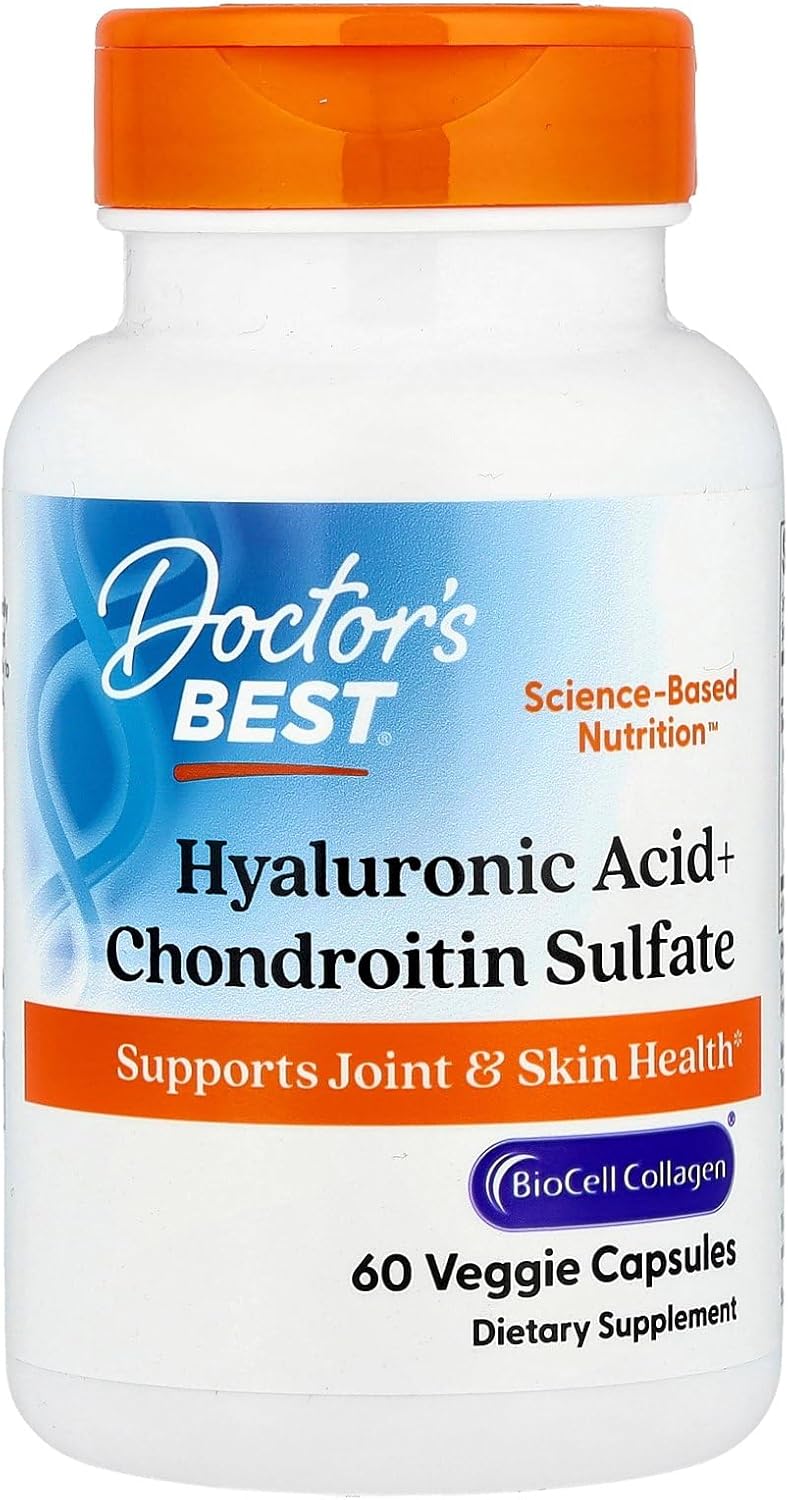
Doctor's Best BioCell Collagen with Hydrolyzed Type II Collagen, HA & Chondroitin
- Not suitable for vegans or vegetarians — derived from chicken sternum, which is a hard stop for a meaningful portion of this audience
- The HA content within 1,000mg BioCell Collagen is not individually quantified on the label, so you can't confirm exactly how much HA you're getting per serving
Affiliate link: If you buy through this link, we may earn a commission at no extra cost to you.
Buy Doctor's Best BioCell Collagen with Hydrolyzed Type II Collagen, HA & Chondroitin
Jarrow Formulas Hyaluronic Acid 120mg
A clean, no-frills 120mg sodium hyaluronate capsule from a trusted brand — solid for purists, but the price and lack of MW specification make it harder to justify over the competition.
Affiliate link: If you buy through this link, we may earn a commission at no extra cost to you.
Buy Jarrow Formulas Hyaluronic Acid 120mgCompare supplements with the same checklist we use.
Get the anti-aging supplement cheat sheet with evidence prompts, safety checks, and label-quality questions before you buy.
Comparison Table
| Category | #1 Nature's Bounty Hyaluronic Acid with Vitamin C Nature's Bounty | #2 NOW Foods Hyaluronic Acid 100mg NOW Foods | #3 Doctor's Best BioCell Collagen with Hydrolyzed Type II Collagen, HA & Chondroitin Doctor's Best | #4 Jarrow Formulas Hyaluronic Acid 120mg Jarrow Formulas |
|---|---|---|---|---|
| Score | 9.1/10 | 8.8/10 | 8.5/10 | 8/10 |
| Best For | Adults 30–60 looking for an accessible, well-reviewed daily HA supplement to support skin hydration, particularly those who already manage their Vitamin C intake through diet and want a convenient skin-focused stack | Vegan or vegetarian adults who want a comprehensive skin-support formula rather than a standalone HA capsule, and who are comfortable with a slightly lower HA dose in exchange for co-factor support | Non-vegetarian adults who want a collagen-plus-HA combination product with patented clinical backing — particularly those with both skin and joint concerns who want one supplement to address both | Minimalist supplementers and those with multiple sensitivities who need a vegan, additive-free 120mg HA capsule and trust the Jarrow brand specifically |
| Pros |
|
|
|
|
| Cons |
|
|
|
What to Know About Hyaluronic Acid for Skin Health
Your skin is roughly 50% hyaluronic acid by total body content — and after age 30, that number drops steadily. By your mid-40s, you may retain only half the HA you had at 20. That loss shows up as dullness, fine lines, and skin that just doesn't 'plump' the way it used to. Topical serums help at the surface, but they can't replace what's been lost in the deeper dermis. That's where oral hyaluronic acid comes in. Oral HA works differently than your serum. Taken as a supplement, low-molecular-weight hyaluronic acid is absorbed through the gut and distributed systemically, where research suggests it may help support dermal water retention and skin barrier function. A 2023 randomized double-blind trial by Gao et al. found measurable improvements in skin moisture and condition following oral HA supplementation — which is meaningful, because blinded skin trials are notoriously hard to run and show effects in. We've evaluated four well-formulated products across price points, certification levels, and ingredient approaches. Whether you're looking for a standalone HA capsule, a cofactor-enhanced formula, or a synergistic collagen-HA complex, there's a meaningful option here. All four are third-party tested. None cost more than $0.55 per day.
This content is for educational purposes only and is not medical advice. These statements have not been evaluated by the FDA. This product is not intended to diagnose, treat, cure, or prevent any disease.
Key Benefits of Hyaluronic Acid for Skin Health
May support deeper dermal hydration by helping maintain the water-binding matrix in the skin's connective tissue — addressing moisture loss that topical products can't fully reach
Research suggests oral HA may contribute to visible reductions in fine line depth and improvements in skin elasticity over 8–12 weeks of consistent use
Complements collagen supplementation by addressing water retention in the dermal scaffold — collagen provides structure, HA provides the hydration volume within it
How Hyaluronic Acid Supports Skin Health
Hyaluronic acid is a glycosaminoglycan — a long-chain sugar molecule with an extraordinary ability to bind water. A single gram of HA can hold up to six liters of water, which explains why it's such a critical structural component of the skin's dermis. In young skin, fibroblasts continuously synthesize HA to maintain the hydrated, plump quality of the extracellular matrix. With age (and accelerated by UV exposure and declining estrogen), both HA synthesis slows and enzymatic degradation increases, leading to a net loss of dermal water-binding capacity. When taken orally, high-molecular-weight HA is broken down during digestion into smaller fragments. Low-molecular-weight HA (generally below 10 kDa) is believed to cross the intestinal barrier and enter systemic circulation, where it may be distributed to skin tissue and stimulate fibroblast activity. The mechanism isn't fully mapped in humans, but the current working model — supported by the RCT data — is that absorbed HA fragments act both directly (contributing to dermal HA pools) and indirectly (stimulating endogenous HA synthesis via fibroblast signaling). This is why molecular weight matters so much when evaluating a product: HA that's too large may not be absorbed efficiently, while low-MW or enzymatically hydrolyzed HA has the most clinical support for systemic skin effects.
What to Look For When Buying Hyaluronic Acid
The single most important thing to understand when buying an oral HA supplement is molecular weight — and most labels don't tell you. High-molecular-weight HA (above 500 kDa) is poorly absorbed through the intestinal wall and is better suited for topical applications. Low-molecular-weight HA (below 50 kDa, ideally below 10 kDa) is the form that research suggests crosses the gut barrier and reaches systemic circulation. When you see a label that just says 'hyaluronic acid 120mg' without any MW specification, you're making an educated guess about bioavailability. That's not a dealbreaker — most products in this category have similar gaps — but it's worth knowing. Dose matters, and the clinical trials provide useful benchmarks. Human studies on oral HA for skin outcomes have generally used 120–200mg per day. Products delivering 100mg (like the NOW formula) are at the lower end of that range, while 120mg products (Jarrow, Nature's Bounty) sit more squarely in the evidenced zone. Going significantly below 80mg per day puts you outside the range where meaningful skin effects have been documented in RCTs. Source is another consideration the label should answer clearly. Bacterial fermentation (Streptococcus equi or similar) produces HA without animal inputs — making it vegan-appropriate and generally very pure. Rooster comb is a traditional animal-derived source with a long history of use but is obviously unsuitable for vegans. BioCell Collagen's chicken-derived matrix is a third category entirely — a whole-matrix ingredient where HA is part of a complex rather than an isolated compound. Finally, think about what problem you're actually solving. If skin hydration is your only concern and you're already taking a good collagen supplement, a standalone HA capsule (Jarrow or Nature's Bounty) is elegant and sufficient. If you're starting fresh and want a single supplement to address both skin structure and hydration, the Doctor's Best BioCell product makes strong logical and economic sense. And if you're vegan and want co-factor support alongside your HA, NOW Foods is genuinely the only option on this list that checks all those boxes simultaneously.
Dosage Guidance
Always follow your healthcare provider's recommendations. Dosages vary by individual health status, age, and goals.
Common Hyaluronic Acid Complaints (And How to Avoid Them)
Based on analysis of thousands of customer reviews across Hyaluronic Acid products.
"I've been taking HA for a month and don't see any difference in my skin"
One month is below the timeline used in most successful clinical trials, which ran for 8–12 weeks. Skin turnover and dermal matrix remodeling are genuinely slow. We recommend committing to a consistent 90-day trial before assessing results — and making sure you're also maintaining adequate baseline hydration, since HA works by binding water that needs to be present in the body.
"The HA capsule upset my stomach"
Taking HA with a meal typically reduces GI discomfort significantly. If discomfort persists, consider switching to a fermentation-derived HA product (like NOW Foods) if you're currently using an animal-sourced option, as the purity profile differs. Persistent GI issues with any supplement are worth discussing with your healthcare provider.
"I can't tell if it's the HA or my moisturizer that's making my skin look better"
This is a real attribution challenge with any oral supplement for skin. If you want to isolate HA's contribution, introduce it as the only new variable — keep your topical routine unchanged for the full trial period. A simple phone-camera photo log at weeks 0, 4, 8, and 12 under consistent lighting gives you a more objective record than memory alone.
Safety & Interactions
- Pregnancy and breastfeeding: Consult your healthcare provider before taking this supplement during pregnancy or while nursing. The safety of supplemental doses beyond dietary intake has not been established in pregnant or lactating women.
- Blood thinners: If you take blood-thinning medications (e.g., warfarin, apixaban, rivaroxaban, clopidogrel, or high-dose aspirin), consult your healthcare provider BEFORE starting this supplement, as it may have additive antiplatelet or anticoagulant effects.
- Kidney disease: If you have chronic kidney disease (CKD) or any significant kidney impairment, consult your healthcare provider before taking this supplement. Some supplements can accumulate to dangerous levels when kidney function is reduced.
- Gout: Individuals with gout should consult their healthcare provider before starting this supplement. Certain supplements (e.g., collagen, fish oil, niacin) may affect uric acid levels or trigger flares in susceptible individuals.
- Important: This supplement is not a replacement for prescription medications. It is supportive for individuals with low baseline status, not a treatment for diagnosed conditions (anxiety disorders, insomnia, hypertension, osteoporosis, etc.). Do not stop or reduce any prescription without consulting your doctor.
""As a registered dietitian, I appreciate that every product on this list is GMP-certified and third-party tested — that's the floor, not the ceiling, of what I'd recommend to clients. The molecular weight transparency gap across most of these labels is a genuine clinical limitation I'd like to see the industry address; until manufacturers routinely specify MW on labels, the BioCell Collagen product's partial characterization gives it a formulation edge that isn't obvious from sticker price alone."
— Angelique Nicole R. Villegas, RND, Registered Nutritionist Dietitian · PRC Philippines · License #0023950
Frequently Asked Questions
Citations & Research
This page references peer-reviewed research indexed on PubMed/NCBI. Citations are provided for transparency. Always consult a qualified healthcare professional before making any medical decisions.
- [3]Gao YR, Wang RP, Zhang L et al. “Oral administration of hyaluronic acid to improve skin conditions via a randomized double-blind clinical test.” Skin Research and Technology, 2023. doi:10.1111/srt.13531PMID 38009035 ↗
- [5]Amin P, Sarabi A, Choe S et al. “Oral Hyaluronic Acid Supplement: Efficacy in Skin Hydration, Elasticity, and Wrinkle Depth Reduction.” Journal of Drugs in Dermatology, 2025. doi:10.36849/jdd.8542PMID 40911749 ↗
- [1]Danessa G, Notario D, Regina R. “Effects of collagen-based supplements on skin's hydration and elasticity: A systematic review and meta-analysis.” Indian Journal of Dermatology, Venereology and Leprology, 2025. doi:10.25259/IJDVL_1165_2023PMID 40826844 ↗
- [4]Inoue N, Sugihara F, Wang X. “Ingestion of bioactive collagen hydrolysates enhance facial skin moisture and elasticity and reduce facial ageing signs in a randomised double-blind placebo-controlled clinical study.” Journal of the Science of Food and Agriculture, 2016. doi:10.1002/jsfa.7606PMID 26840887 ↗
Ready to Try Hyaluronic Acid?
Our top pick for skin health. Third-party tested, highly reviewed.
Affiliate link: If you buy through this link, we may earn a commission at no extra cost to you.
Shop #1 Pick — Nature's Bounty Hyaluronic Acid with Vitamin CContinue exploring
- Hyaluronic Acid evidence overviewSupplement overview
- what we recommend for skin healthGoal overview
- see Collagen evidence for skin healthAlternative supplement
- Glutathione guidance for skin healthAlternative supplement
- Hyaluronic Acid options for joint healthSame supplement, different goal
- how Collagen supports joint healthEditor pick
- see how supplements stacks up to food sourcesCompare options
Get the evidence-graded supplement cheat sheet.
Evidence prompts, safety checks, and label-quality questions before you buy — free, straight to your inbox.
No spam. Unsubscribe anytime.