
Best Creatine for Menopause: Evidence-Based Picks for Women 40+
Creatine for women 40+ in peri- and post-menopause. Evidence-based picks for lean mass, strength, and bone — honest dosing and YMYL safety inside.
general); Moderate (menopause-specific

This content is for educational purposes only and is not medical advice. These statements have not been evaluated by the FDA. This product is not intended to diagnose, treat, cure, or prevent any disease. Always consult your healthcare provider before starting any supplement.
Best Creatine for Menopause Support in 2026
Ranked by quality, value, and clinical backing
Where available, we show when each product price was last checked so the list stays honest without overreacting to normal Amazon price movement.

Thorne Creatine
Our editorial pick for women 40+ who want the most rigorously independently verified product in this lineup. NSF Certified for Sport — the most rigorous third-party testing standard in the supplement industry, verifying both label accuracy and the absence of banned substances. The trade-off is real: roughly 3x the per-serving cost of the other two picks for the same active ingredient, creatine monohydrate.
- Highest per-serving cost in this lineup — meaningful for a long-term daily habit
- NSF certification rigor may be more than non-athletes need
Affiliate link: If you buy through this link, we may earn a commission at no extra cost to you.
Buy Thorne Creatine
Optimum Nutrition Micronized Creatine Monohydrate Powder
The best-selling and most-reviewed creatine monohydrate in this lineup, at roughly a third of Thorne's per-serving cost. The product listing states Banned Substance Tested, and the micronized formulation mixes more easily than standard powder. A practical default for most women 40+ who want to take creatine consistently without the Thorne premium.
- Listing names 'Banned Substance Tested' generically rather than a specific named certification program like Thorne's NSF Certified for Sport
- No additional certifications (GMP, Non-GMO) listed on the product page
Affiliate link: If you buy through this link, we may earn a commission at no extra cost to you.
Buy Optimum Nutrition Micronized Creatine Monohydrate Powder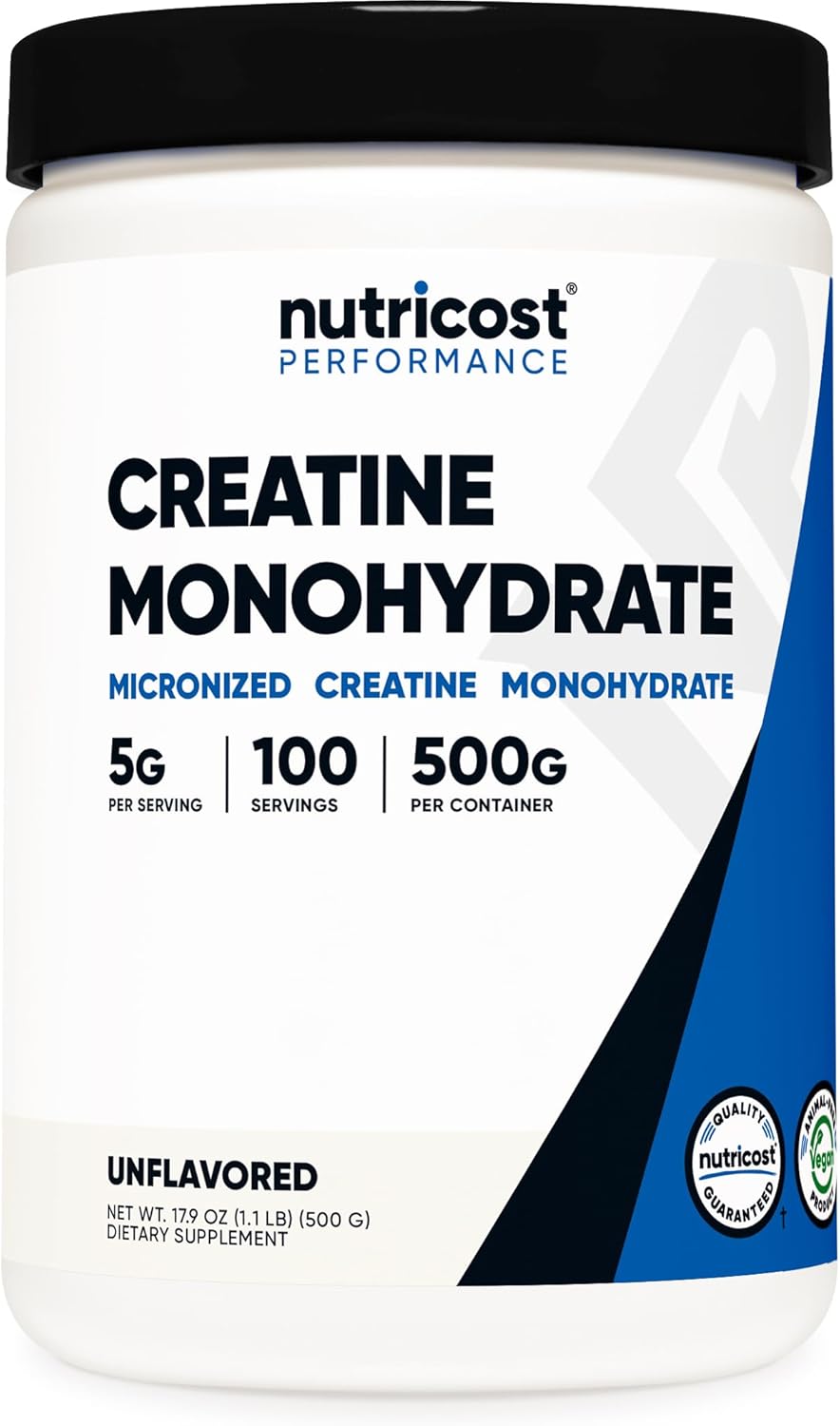
Nutricost Creatine Monohydrate
The lowest per-serving cost in this lineup for the same active ingredient, creatine monohydrate, with a large verified-review base and a GMP-certified, Non-GMO facility. A defensible choice for women 40+ who want the most affordable long-term daily habit and don't need a named sport-certification program.
- No sport-specific banned-substance certification named on the label
- Less brand recognition among clinicians than Thorne or Optimum Nutrition
Affiliate link: If you buy through this link, we may earn a commission at no extra cost to you.
Buy Nutricost Creatine MonohydrateCompare supplements with the same checklist we use.
Get the anti-aging supplement cheat sheet with evidence prompts, safety checks, and label-quality questions before you buy.
Comparison Table
| Category | #1 Thorne Creatine Thorne | #2 Optimum Nutrition Micronized Creatine Monohydrate Powder Optimum Nutrition | #3 Nutricost Creatine Monohydrate Nutricost |
|---|---|---|---|
| Score | 9.1/10 | 8.9/10 | 8.6/10 |
| Best For | Women 40+ who want the highest independently-verified manufacturing and certification rigor — particularly those who train competitively or are subject to drug testing | Women 40+ who want the most-reviewed, best-selling creatine monohydrate at a moderate per-serving cost | Women 40+ who want the most affordable creatine monohydrate option for a long-term daily habit |
| Pros |
|
|
|
| Cons |
|
|
|
What to Know About Creatine for Menopause Support
Creatine spent two decades reputed as a supplement for male bodybuilders and college-age athletes. That framing was always too narrow, and the last five years of clinical research has made it indefensible. The most directly relevant body of work for this page — Smith-Ryan et al.'s 2021 women's lifespan review in Nutrients (PMID 33800439) and the 2025 menstruation-to-menopause review in the Journal of the International Society of Sports Nutrition (PMID 40371844) — has reframed creatine as one of the few non-hormonal supplements with credible evidence for the lean-mass, strength, and bone changes that define the perimenopause and post-menopause window. The biological case is clean. Estrogen decline in the menopause transition accelerates sarcopenia — the age-related loss of skeletal muscle — and reduces resistance-training adaptive response. Creatine works through a mechanism that is partly independent of the estrogen pathway: it expands muscle phosphocreatine stores, increasing the rate at which ATP is regenerated during high-effort contractions. In the context of resistance training, this allows for slightly higher training volume per session, which over months translates into measurably more lean mass and strength than training alone. Candow et al. (2021, PMID 34107512) tested 5 g/day creatine plus resistance training in older adults over 12 months and reported significant increases in lean mass and bone variables versus placebo plus resistance training. The Lanhers 2015 meta-analysis (PMID 25946994) of creatine and lower-limb strength found a consistent positive pooled effect across 24 RCTs. This page ranks three creatine monohydrate products — Thorne, Optimum Nutrition, and Nutricost — for women 40+ in the menopause transition. All three deliver a full 5 g serving of creatine monohydrate, the form with the entire relevant RCT evidence base; Thorne carries NSF Certified for Sport (independent SKU-level verification of label accuracy and banned-substance absence), and Optimum Nutrition's listing states Banned Substance Tested. Research suggests creatine may support lean mass, strength, and exercise performance in women across the menopause transition when paired with consistent resistance training, but no product on this page is a treatment for sarcopenia, osteoporosis, menopausal mood symptoms, or any medical condition. The distinction matters, and we'll be precise about it throughout. If you have severe bone-density loss, a diagnosed cardiovascular condition, kidney disease, or are managing a serious perimenopause symptom cluster, this page is a starting point for an informed clinician conversation, not a substitute for one.
This content is for educational purposes only and is not medical advice. These statements have not been evaluated by the FDA. This product is not intended to diagnose, treat, cure, or prevent any disease.
Key Benefits of Creatine for Menopause Support
Research suggests creatine paired with consistent resistance training may support lean muscle mass and strength in women across the menopause transition (Smith-Ryan 2021 lifespan review PMID 33800439; Smith-Ryan 2025 update PMID 40371844)
May support lower-body strength outcomes in adults across age ranges (Lanhers 2015 meta-analysis of 24 RCTs, PMID 25946994) — relevant to fall and fracture risk in the post-menopause window
Generally well-tolerated at the 3–5 g/day maintenance dose used in clinical trials, with the most common reported side effect (mild GI discomfort or transient water-weight gain) typically resolving within the first two weeks of use
How Creatine Supports Menopause Support
Creatine is a naturally occurring nitrogenous compound that your body synthesizes from amino acids (arginine, glycine, methionine) at roughly 1 g/day, with additional intake from red meat and fish. Inside muscle cells, creatine is phosphorylated to phosphocreatine, which serves as the primary high-speed energy buffer for ATP regeneration during high-effort contractions. Resistance training — the activity most directly tied to lean-mass and strength outcomes in the menopause window — relies heavily on this phosphocreatine system. Supplemental creatine monohydrate at 3–5 g/day saturates muscle phosphocreatine stores over about 28 days (faster with a loading phase, slower without). At saturation, you can perform slightly more high-effort training volume per session — one or two more repetitions per set at near-maximal load, or a small increase in load at the same rep range. Over weeks and months, this small training-volume increase compounds into measurably greater lean mass and strength gains compared to training without creatine. This is the core mechanism behind the menopause-specific benefit documented in the Smith-Ryan reviews and the Candow 2021 RCT. A critical practical point: creatine's benefit is meaningfully tied to resistance training. Creatine without training delivers minimal lean-mass or strength benefit in the menopause window. The Smith-Ryan and Candow research consistently pairs the two interventions. If you're not currently doing resistance training, the highest-leverage step is starting a program — creatine is the adjunct, not the foundation. For cognitive and mood endpoints, the proposed mechanism is similar but acts in brain tissue rather than skeletal muscle: creatine supports ATP regeneration in neurons during high cognitive demand. Some research has explored whether this brain-energy buffering matters more during periods of cognitive stress or sleep deprivation. We are explicit that this mechanistic pathway has not yet been confirmed for menopause-specific cognitive endpoints in RCTs.
What to Look For When Buying Creatine
The single most important decision in creatine-for-menopause shopping is not the brand — it's the form. Creatine monohydrate has the entire menopause-relevant RCT evidence base behind it. Newer forms (creatine HCl, buffered creatine, creatine ethyl ester) have repeatedly failed to outperform monohydrate in head-to-head trials despite glossier marketing. Pay no premium for non-monohydrate forms — the evidence does not support it. Independent verification matters next. We only credit a testing or certification claim we can confirm directly on the product's Amazon listing. Thorne states NSF Certified for Sport — SKU-level independent testing for label accuracy and banned-substance absence. Optimum Nutrition's listing states Banned Substance Tested. Nutricost's listing does not carry a named sport-certification claim; it is GMP-certified and Non-GMO verified. All three are creatine monohydrate, the chemically identical active compound used in the cited clinical research — we do not assert a specific manufacturing source (such as Creapure) for any product here, because we could not verify that claim on any of the three listings. Dose translation is simple: 3–5 g/day, taken consistently. Loading phases (20 g/day for 5–7 days) saturate muscle phosphocreatine stores faster, but 5 g/day reaches the same saturation level in about 28 days. For a long-term menopause-window habit, skipping the loading phase is reasonable. Timing of dose (pre-workout, post-workout, morning) does not appear to matter meaningfully — consistency does. Certification is worth thinking through honestly. NSF Certified for Sport (Thorne) involves independent SKU-level testing for label accuracy, banned substance absence, and manufacturing compliance — meaningful if you compete in a sport with WADA, USADA, NCAA, or other governing-body testing. For a 52-year-old who wants to maintain strength and lean mass through perimenopause without testing concerns, Optimum Nutrition's Banned Substance Tested listing or Nutricost's GMP-certified, Non-GMO facility both cover the practical assurance most users need, at a fraction of Thorne's cost. Resistance training is the partner intervention. Creatine without training delivers minimal benefit in the menopause window. The Smith-Ryan and Candow research consistently pairs the two. If you're not currently lifting, starting a 2–3x/week resistance program (or working with a trainer to do so safely) is the highest-leverage step — creatine is the adjunct, not the foundation. Protein matters too: 1.2–1.6 g/kg/day is the range that supports both lean mass maintenance and the creatine response. Food-first note: creatine supplementation does not replace the menopause-window basics — protein-forward eating, resistance training 2–3x/week, adequate sleep, calcium and vitamin D adequacy for bone, and an informed conversation with a menopause-literate clinician about whether hormone therapy is right for you. Creatine layers on top of those, not instead of them.
Dosage Guidance
Always follow your healthcare provider's recommendations. Dosages vary by individual health status, age, and goals.
Common Creatine Complaints (And How to Avoid Them)
Based on analysis of thousands of customer reviews across Creatine products.
"I've been on creatine for 6 weeks and the scale is up but I don't feel stronger"
Six weeks is at the lower edge of when strength and lean-mass changes become measurable, and the scale weight you're seeing is most likely intracellular water (a feature of the mechanism, not a problem). The honest next step is to check your training: are you progressively overloading (adding load or volume across weeks), or running the same workout repeatedly? Creatine amplifies the response to progressive training stimulus — without progression, the supplement has less to amplify. If you're confident the training program is sound, give it another 6–8 weeks before reassessing.
"I have mild kidney disease and my doctor said no creatine — but everyone online says it's safe"
Your doctor is right. Creatine in CKD is genuinely contraindicated without nephrology oversight — this is not a 'supplement industry caution that doesn't really apply.' The mechanism that makes creatine useful (loading muscle phosphocreatine, with creatinine as the breakdown product) interacts with already-impaired kidney filtration in ways that are not fully characterized and can be clinically meaningful. For lean-mass support with mild CKD, the safer foundation is protein 1.0–1.2 g/kg/day (adjusted for CKD stage with your nephrologist), resistance training, and clinical management of the underlying condition. Do not start creatine over your nephrologist's objection.
"I'm taking tamoxifen — can I take creatine?"
No specific pharmacokinetic interaction between creatine and tamoxifen has been documented in published clinical work. That said, the practical advice is to mention creatine to your oncology team — primarily so they are aware of all supplements you take rather than because of a specific known interaction. The same applies to raloxifene, aromatase inhibitors, and any other hormone-directed prescription. Your oncology team is the right authority on this, not a consumer product page.
Safety & Interactions
- Pregnancy and breastfeeding: Consult your healthcare provider before taking this supplement during pregnancy or while nursing. The safety of supplemental doses beyond dietary intake has not been established in pregnant or lactating women.
- Blood thinners: If you take blood-thinning medications (e.g., warfarin, apixaban, rivaroxaban, clopidogrel, or high-dose aspirin), consult your healthcare provider BEFORE starting this supplement, as it may have additive antiplatelet or anticoagulant effects.
- Kidney disease: If you have chronic kidney disease (CKD) or any significant kidney impairment, consult your healthcare provider before taking this supplement. Some supplements can accumulate to dangerous levels when kidney function is reduced.
- Gout: Individuals with gout should consult their healthcare provider before starting this supplement. Certain supplements (e.g., collagen, fish oil, niacin) may affect uric acid levels or trigger flares in susceptible individuals.
- Important: This supplement is not a replacement for prescription medications. It is supportive for individuals with low baseline status, not a treatment for diagnosed conditions (anxiety disorders, insomnia, hypertension, osteoporosis, etc.). Do not stop or reduce any prescription without consulting your doctor.
""What I'd emphasize for women in the menopause window: creatine is one of the most well-evidenced non-hormonal adjuncts for the lean-mass and strength side of the transition — but the evidence is for creatine plus resistance training, not creatine alone. The binding constraint for most women 40+ is consistent training stimulus, not the supplement. Start there. Add creatine (5 g/day creatine monohydrate, any of the products on this page) once you have a sustainable 2–3x/week lifting routine in place. Pair both with 1.2–1.6 g/kg/day protein, adequate sleep, and an informed conversation with a menopause-literate clinician about hormone therapy. That's the stack."
— Angelique Nicole R. Villegas, RND, Registered Nutritionist Dietitian · PRC Philippines · License #0023950
Frequently Asked Questions
Citations & Research
This page references peer-reviewed research indexed on PubMed/NCBI. Citations are provided for transparency. Always consult a qualified healthcare professional before making any medical decisions.
- [1]Smith-Ryan AE, Cabre HE, Eckerson JM, Candow DG. “Creatine Supplementation in Women's Health: A Lifespan Perspective.” Nutrients, 2021. doi:10.3390/nu13030877PMID 33800439 ↗
- [2]Smith-Ryan AE, DelBiondo GM, Brown AF et al. “Creatine in women's health: bridging the gap from menstruation through pregnancy to menopause.” Journal of the International Society of Sports Nutrition, 2025. doi:10.1080/15502783.2025.2500021PMID 40371844 ↗
- [3]Candow DG, Chilibeck PD, Gordon JJ et al. “Efficacy of Creatine Supplementation and Resistance Training on Area and Density of Bone and Muscle in Older Adults.” Medicine & Science in Sports & Exercise, 2021. doi:10.1249/MSS.0000000000002722PMID 34107512 ↗
- [4]Lanhers C, Pereira B, Naughton G, Trousselard M, Lesage FX, Dutheil F. “Creatine Supplementation and Lower Limb Strength Performance: A Systematic Review and Meta-Analyses.” Sports Medicine, 2015. doi:10.1007/s40279-015-0337-4PMID 25946994 ↗
- [5]Sims ST, Kerksick CM, Smith-Ryan AE et al. “International society of sports nutrition position stand: nutritional concerns of the female athlete.” Journal of the International Society of Sports Nutrition, 2023. doi:10.1080/15502783.2023.2204066PMID 37221858 ↗
Ready to Try Creatine?
Our top pick for menopause support. Third-party tested, highly reviewed.
Affiliate link: If you buy through this link, we may earn a commission at no extra cost to you.
Shop #1 Pick — Thorne CreatineContinue exploring
- our full Creatine reviewSupplement overview
- top-rated menopause support supplementsGoal overview
- our Dong Quai review for menopause supportAlternative supplement
- the Magnesium Glycinate page for menopause supportAlternative supplement
- Creatine research for brain healthSame supplement, different goal
- Creatine for muscle preservationEditor pick
- Creatine and glp 1 muscle loss prevention: what to knowEditor pick
- how we rate NMN for perimenopause supportEditor pick
- our top Magnesium pick for menopause supportEditor pick
- creatine monohydrate vs creatine hcl: our verdictCompare options
Get the evidence-graded supplement cheat sheet.
Evidence prompts, safety checks, and label-quality questions before you buy — free, straight to your inbox.
No spam. Unsubscribe anytime.