
Best Cordyceps Supplements for Energy in 2026
Cordyceps energy evidence is mixed: small older-adult findings conflict with null cyclist trials. See the limited acute C. militaris data and product differences.
This content is for educational purposes only and is not medical advice. These statements have not been evaluated by the FDA. This product is not intended to diagnose, treat, cure, or prevent any disease. Always consult your healthcare provider before starting any supplement.
Best Cordyceps for Energy in 2026
Ranked by quality, value, and clinical backing
Where available, we show when each product price was last checked so the list stays honest without overreacting to normal Amazon price movement.
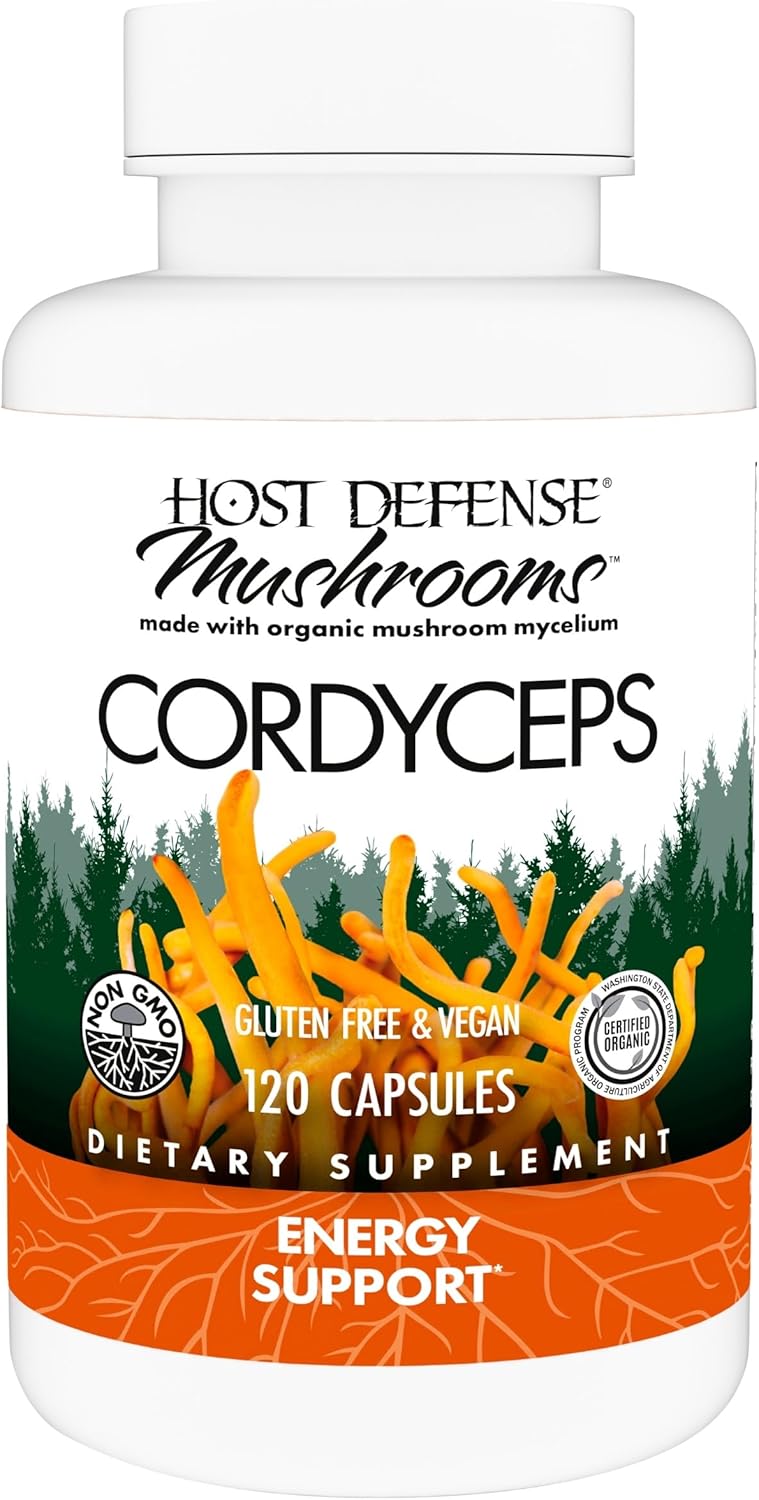
Host Defense Cordyceps Capsules, 120 Capsules
Host Defense Cordyceps Capsules, 120 Capsules. 4.6★ (1,576 ratings). Confirmed in stock.
- Premium price point relative to comparable options
Affiliate link: If you buy through this link, we may earn a commission at no extra cost to you.
Buy Host Defense Cordyceps Capsules, 120 Capsules
Real Mushrooms Supplement Capsules Cordyceps Mushroom Powder Rich in Beta Glucans Vegan Non-GMO, 120 Count
Real Mushrooms Supplement Capsules Cordyceps Mushroom Powder Rich in Beta Glucans Vegan Non-GMO, 120 Count. 4.6★ (2,800 ratings). Confirmed in stock.
- Amazon price and availability can change over time
Affiliate link: If you buy through this link, we may earn a commission at no extra cost to you.
Buy Real Mushrooms Supplement Capsules Cordyceps Mushroom Powder Rich in Beta Glucans Vegan Non-GMO, 120 Count
NOW Foods Supplements Cordyceps sinensis 750mg Healthy Immune Support, 90 Veg Capsules
NOW Foods Supplements Cordyceps sinensis 750mg Healthy Immune Support, 90 Veg Capsules. 4.4★ (3,600 ratings). Confirmed in stock.
- Amazon price and availability can change over time
Affiliate link: If you buy through this link, we may earn a commission at no extra cost to you.
Buy NOW Foods Supplements Cordyceps sinensis 750mg Healthy Immune Support, 90 Veg CapsulesCompare supplements with the same checklist we use.
Get the anti-aging supplement cheat sheet with evidence prompts, safety checks, and label-quality questions before you buy.
Comparison Table
| Category | #1 Host Defense Cordyceps Capsules, 120 Capsules Host Defense | #2 Real Mushrooms Supplement Capsules Cordyceps Mushroom Powder Rich in Beta Glucans Vegan Non-GMO, 120 Count Real Mushrooms | #3 NOW Foods Supplements Cordyceps sinensis 750mg Healthy Immune Support, 90 Veg Capsules NOW Foods |
|---|---|---|---|
| Score | 8.8/10 | 8.8/10 | 8.4/10 |
| Best For | |||
| Pros |
|
|
|
| Cons |
|
|
|
What to Know About Cordyceps for Energy
Cordyceps is marketed for energy and endurance, but the human evidence is mixed, small, and formulation-specific. It should not be presented as a proven way to raise daily energy, VO2 max, or athletic performance. One small 12-week Cs-4 trial in healthy older adults (PMID 20804368, n=20) reported threshold changes, while VO2 max did not change in either group. In contrast, two 2004 trials in trained cyclists found no significant endurance, VO2-max, or lactate-threshold benefit: a commercial herbal blend containing cordyceps (PMID 15076794) and CordyMax Cs-4 (PMID 15118196). These conflicting trials mean the older positive result cannot establish a general energy or performance effect. A July 2026 randomized, double-blind, placebo-controlled crossover trial of C. militaris (PMID 42455764) enrolled 12 recreationally active young men and examined acute responses around exhaustive cycling. It reported faster post-exercise reaction time and higher resting VO2, but the condition-by-time interaction and peak VO2 were not significant. This acute, small study does not show improved peak aerobic capacity, sustained energy, or a reliable performance benefit. Cordyceps is not a stimulant. Product labels also do not make Cs-4 and C. militaris interchangeable with the preparations studied in these trials. If fatigue, declining exercise tolerance, or reduced function is new, severe, or persistent, seek clinical assessment rather than self-treating with a supplement.
This content is for educational purposes only and is not medical advice. These statements have not been evaluated by the FDA. This product is not intended to diagnose, treat, cure, or prevent any disease.
Key Benefits of Cordyceps for Energy
A small 12-week Cs-4 trial in healthy older adults reported threshold changes without a VO2-max change; this conflicts with null trials in trained cyclists and does not prove an everyday-energy benefit
The acute C. militaris crossover trial (PMID 42455764, n=12) found faster post-exercise reaction time and higher resting VO2, not a significant peak-VO2 or condition-by-time benefit
Species, formulation, dose, duration, and participant populations differ across studies, so no retail product can be assumed to reproduce a trial result
How Cordyceps Supports Energy
Cordycepin and related compounds are being studied in laboratory and animal systems, but those mechanistic observations do not establish a human energy or endurance benefit. The available trials do not identify a reliable human pathway that improves VO2 max, ATP production, or athletic performance. Cs-4 and C. militaris are distinct preparations. The small Cs-4 trial and the n=12 acute C. militaris crossover study used different populations and outcomes, so compound content or species identity cannot be used to infer clinical superiority for a retail product. Cordycepin vs cordycepic acid: Cordycepin (3'-deoxyadenosine) is the compound most often discussed in relation to adenosine signaling, mitochondrial stress responses, and ATP-related hypotheses. Cordycepic acid (D-mannitol) is easier to standardize on labels but has less direct relevance to energy or performance mechanisms. This distinction can help interpret labels, but it does not prove that a higher-cordycepin retail product will improve everyday energy.
For coq10 for energy, review its separate evidence base; the cordyceps trials do not establish a combined benefit or a shared clinical mechanism.
The cordyceps for athletic performance page reviews the same small, mixed and preparation-specific evidence without treating it as proof of competitive-performance benefit.
What to Look For When Buying Cordyceps
Choose a cordyceps product for transparent identity, disclosed ingredient amounts, and quality documentation—not because one form is proven more effective for energy or athletic performance. Cs-4 and C. militaris are different preparations studied in different populations and protocols; the available trials do not show that they are clinically interchangeable. A study dose is not a validated consumer dosing target. The older Cs-4 study used 333 mg three times daily (about 1 g/day) for 12 weeks, whereas PMID 42455764 used one 1 g C. militaris dose acutely. Neither result establishes what another product, dose, or formulation will do. Treat marketing claims about species, active-compound content, and wild sourcing as product-identity claims. They do not establish efficacy, safety in combinations, or superiority over another preparation. Fruiting body vs mycelium: Fruiting body contains different compound profiles than mycelium grown on grain, and some analyses report higher cordycepin concentrations in C. militaris fruiting bodies. However, no human trial has directly compared fruiting body to mycelium for energy or athletic performance. The Cs-4 strain used in Chen 2010 was a specific mycelium preparation, not a fruiting-body extract. Treat fruiting body superiority as a compound-content hypothesis, not a proven energy outcome. Food-first note: Cordyceps is not a dietary staple in Western diets. Traditional use involves whole fruiting bodies in soups or teas, but in 2026 there are no widely available food sources that reliably match the doses used in research. Supplementation is the only practical route for people trying to approximate studied intakes, though the evidence still does not establish a reliable consumer benefit. Product note: Host Defense Cordyceps lists 120 capsules at $47.21 in the current product data, which is about $0.39 per capsule. At a 1g serving of two capsules, that is about $0.78/day. A Cs-4 option such as Jarrow can be medically relevant for consistency with the athletic-performance page, but adding a new ranked product should wait for affiliate-link and product-identity verification.
Dosage Guidance
Always follow your healthcare provider's recommendations. Dosages vary by individual health status, age, and goals.
Common Cordyceps Complaints (And How to Avoid Them)
Based on analysis of thousands of customer reviews across Cordyceps products.
""I took cordyceps before my workout expecting an energy boost but felt nothing""
The trials reviewed here do not establish an acute energy effect, a long-term energy-production effect, or a practical timing regimen. PMID 42455764 was a single-dose study and did not show a significant condition-by-time interaction or peak-VO2 benefit. Do not use cordyceps as a substitute for evaluating fatigue or for evidence-based training and nutrition guidance.
""The cordyceps I bought says it's from Tibet — is it genuine wild cordyceps?""
Check the product label for the named species or strain, amount per serving, and available quality documentation. A label claim does not establish that a product matches a study preparation or has a proven energy or performance effect.
""Does cordyceps raise testosterone or is that just bro science?""
The exercise trials on this page do not establish a testosterone effect. Avoid choosing cordyceps for testosterone, energy, or performance claims that are not supported by an appropriate human study.
Safety & Interactions
- Pregnancy and breastfeeding: Consult your healthcare provider before taking this supplement during pregnancy or while nursing. The safety of supplemental doses beyond dietary intake has not been established in pregnant or lactating women.
- Blood thinners: If you take blood-thinning medications (e.g., warfarin, apixaban, rivaroxaban, clopidogrel, or high-dose aspirin), consult your healthcare provider BEFORE starting this supplement, as it may have additive antiplatelet or anticoagulant effects.
- Kidney disease: If you have chronic kidney disease (CKD) or any significant kidney impairment, consult your healthcare provider before taking this supplement. Some supplements can accumulate to dangerous levels when kidney function is reduced.
- Gout: Individuals with gout should consult their healthcare provider before starting this supplement. Certain supplements (e.g., collagen, fish oil, niacin) may affect uric acid levels or trigger flares in susceptible individuals.
- Fish allergy - capsule source: Some softgel capsules use fish-derived gelatin even when the active supplement is not fish-derived. If you have a confirmed fish or shellfish allergy, verify the capsule source on the label or check with the manufacturer. Vegan capsules (vegetable cellulose) are widely available alternatives.
- Beef / alpha-gal allergy - capsule source: Many softgel and two-piece capsules use bovine gelatin. If you have a confirmed beef allergy or alpha-gal syndrome (mammalian meat allergy), check capsule sources on the label. Vegan capsules (vegetable cellulose) and HPMC capsules are alternatives.
""Cordyceps has mixed, formulation-specific human evidence rather than a demonstrated treatment for age-related energy decline. The small older Cs-4 signal must be read alongside null cyclist trials, and the n=12 acute C. militaris study does not establish a peak-VO2 or endurance benefit. Product composition may matter, but it cannot be used to infer clinical efficacy from one species or preparation to another."
— Angelique Nicole R. Villegas, RND, Registered Nutritionist Dietitian · PRC Philippines · License #0023950
Frequently Asked Questions
Citations & Research
This page references peer-reviewed research indexed on PubMed/NCBI. Citations are provided for transparency. Always consult a qualified healthcare professional before making any medical decisions.
- [1]Chen S, Li Z, Krochmal R, Abrazado M, Kim W, Cooper CB. Effect of Cs-4 (Cordyceps sinensis) on exercise performance in healthy older subjects: a double-blind, placebo-controlled trial. J Altern Complement Med. 2010;16(5):585-590.PMID 20804368 ↗
- [2]Earnest CP, Morss GM, Wyatt F et al. “Effects of a commercial herbal-based formula on exercise performance in cyclists.” Medicine and science in sports and exercise, 2004. doi:10.1249/01.mss.0000125157.49280.afPMID 15076794 ↗
- [3]Parcell AC, Smith JM, Schulthies SS et al. “Cordyceps Sinensis (CordyMax Cs-4) supplementation does not improve endurance exercise performance.” International journal of sport nutrition and exercise metabolism, 2004. doi:10.1123/ijsnem.14.2.236PMID 15118196 ↗
- [4]PMID 42455764 ↗
Ready to Try Cordyceps?
Our top pick for energy. Third-party tested, highly reviewed.
Affiliate link: If you buy through this link, we may earn a commission at no extra cost to you.
Shop #1 Pick — Host Defense Cordyceps Capsules, 120 CapsulesContinue exploring
- Cordyceps supplement guideSupplement overview
- what we recommend for energyGoal overview
- B Complex reviewed for energyAlternative supplement
- CoQ10 fit for energyAlternative supplement
- Cordyceps guidance for athletic performanceSame supplement, different goal
- Echinacea for immune supportEditor pick
- Saccharomyces boulardii — an option to consider for gut healthEditor pick
- supplements vs food sources comparedCompare options
Get the evidence-graded supplement cheat sheet.
Evidence prompts, safety checks, and label-quality questions before you buy — free, straight to your inbox.
No spam. Unsubscribe anytime.