
Best Melatonin Supplements for Jet Lag in 2026
Cochrane review of 10 RCTs: melatonin beats placebo for jet lag — but 0.5mg works as well as 5mg. Timing at destination bedtime is the key.

This content is for educational purposes only and is not medical advice. These statements have not been evaluated by the FDA. This product is not intended to diagnose, treat, cure, or prevent any disease. Always consult your healthcare provider before starting any supplement.
Best Melatonin for Jet Lag in 2026
Ranked by quality, value, and clinical backing
Where available, we show when each product price was last checked so the list stays honest without overreacting to normal Amazon price movement.
Life Extension Melatonin 300mcg
The most evidence-aligned jet lag choice. Life Extension's 0.3mg capsule is the closest commercially available dose to the 0.5mg physiological level used in Cochrane-reviewed jet lag RCTs. At this dose, you get the full MT2-receptor circadian phase-shift with minimal sedation carryover — ideal for travelers who need to be sharp at the destination the day after arrival. Life Extension is a well-established brand with strong quality controls and third-party testing. The fact that this dose is rarely recommended by pharmacists or on product labels reflects the market's misalignment with the jet lag evidence, not a deficiency in the product.
- Not available in most physical pharmacies — requires advance online ordering before travel
- May not provide enough sedation for travelers who also struggle with sleeping in unfamiliar environments; consider 1mg if that applies to you
- 60 capsules per bottle — sufficient for ~12 jet lag trips (5 nights each)

NOW Foods Melatonin 1mg
The best practical all-around jet lag choice. 1mg sits within the physiological dose range and provides slightly more sedation than 0.3mg — useful for the first night or two at destination when circadian misalignment is strongest and sleep in an unfamiliar hotel room is hardest. This is the dose we would recommend to a traveler who asks for a single jet lag melatonin product.
- Cannot split 1mg capsule to achieve 0.5mg for highly sensitive individuals
- Standard capsule onset 30–60 min — take proactively at destination bedtime, not when already in bed
- No NSF or USP certification, though GMP certified and non-GMO verified
Affiliate link: If you buy through this link, we may earn a commission at no extra cost to you.
Buy NOW Foods Melatonin 1mg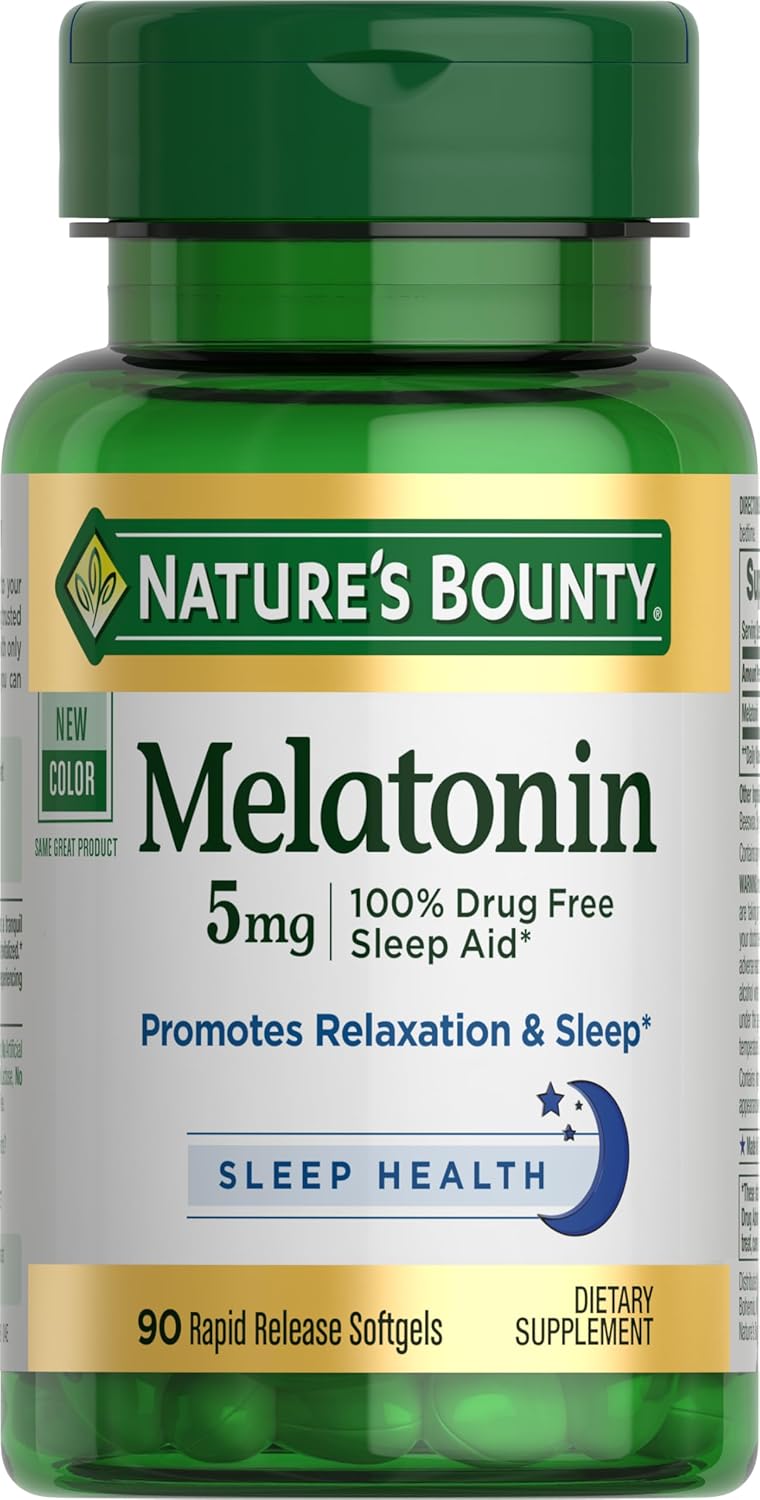
Nature's Bounty Melatonin 5mg
The right choice when jet lag insomnia is the dominant problem. If you are waking at 2–3am destination time and cannot return to sleep — not just struggling to fall asleep at the right time — then 5mg's stronger and longer-lasting sedation may be warranted. With 52,000+ Amazon reviews, Nature's Bounty 5mg is the most-reviewed melatonin product on the market, providing real-world confidence in label accuracy and quality. The dose is pharmacological rather than physiological, but it sits within the Cochrane-reviewed range where efficacy was confirmed. Take it at destination bedtime (not earlier) and allow for 7–8 hours before you need to be alert.
- 5mg is 10–17x endogenous melatonin peak — pharmacological rather than physiological; higher grogginess risk
- Cochrane evidence shows no advantage over 0.5mg for circadian shifting; higher dose provides sedation only
- May delay morning awakening if taken too late or if metabolism is slow; do not take after midnight
Affiliate link: If you buy through this link, we may earn a commission at no extra cost to you.
Buy Nature's Bounty Melatonin 5mgCompare supplements with the same checklist we use.
Get the anti-aging supplement cheat sheet with evidence prompts, safety checks, and label-quality questions before you buy.
Comparison Table
| Category | #1 Life Extension Melatonin 300mcg Life Extension | #2 NOW Foods Melatonin 1mg NOW Foods | #3 Nature's Bounty Melatonin 5mg Nature's Bounty |
|---|---|---|---|
| Score | 9.1/10 | 8.9/10 | 8.3/10 |
| Best For | Business travelers and athletes who need to be fully functional at destination within 24 hours of arrival; travelers who are sensitive to next-day grogginess from melatonin; anyone who wants the physiological dose validated in the Cochrane jet lag studies | Most travelers crossing 5+ time zones; first-time melatonin users for jet lag; those who want one product that covers both circadian shifting and mild sleep assistance at destination | Travelers who wake at 2–3am destination time due to circadian misalignment and need additional sedation to extend sleep duration; those who already use 5mg regularly and have calibrated their response |
| Pros |
|
|
|
| Cons |
|
|
|
What to Know About Melatonin for Jet Lag
Melatonin is the most rigorously tested supplement for jet lag — and the Cochrane evidence base is unusually strong for a supplement claim. The Herxheimer and Petrie Cochrane review (2002, PMID 12076414) pooled 10 randomized controlled trials and found that melatonin taken at destination bedtime was significantly more effective than placebo for reducing jet lag symptoms when crossing five or more time zones. Both low doses (0.5mg) and higher doses (5mg) worked — and there was no statistically significant difference between them for jet lag relief. This is a critical finding that almost every product label and travel health website gets wrong: you do not need 5mg, 10mg, or even 3mg to shift your circadian clock. The chronobiotic effect operates at physiological doses (0.3–1mg). Here is what most travelers misunderstand: melatonin's benefit for jet lag is not sedation. It is circadian phase-shifting — signaling the suprachiasmatic nucleus (your master body clock in the brain) to reset its timing to match the new time zone. This is a fundamentally different mechanism from using melatonin for insomnia. The timing of when you take it is the actual intervention. Taking melatonin when you feel tired on the plane or upon landing at the wrong local time can deepen circadian misalignment rather than resolve it. The correct protocol — take melatonin at 10pm–midnight local time at your destination, starting on the day of arrival — is the evidence-backed approach from the original Arendt et al. 1987 trial and confirmed across subsequent RCTs. This page explains the full protocol, the dose rationale, and ranks products specifically for jet lag use rather than general sleep.
This content is for educational purposes only and is not medical advice. These statements have not been evaluated by the FDA. This product is not intended to diagnose, treat, cure, or prevent any disease.
Key Benefits of Melatonin for Jet Lag
Cochrane review of 10 RCTs: melatonin significantly more effective than placebo for jet lag when crossing 5+ time zones; both 0.5mg and 5mg effective — no significant difference between doses for jet lag relief (Herxheimer & Petrie, 2002, PMID 12076414)
Acts as a chronobiotic via MT1/MT2 receptors in the suprachiasmatic nucleus — directly shifts the circadian clock rather than simply sedating, making it mechanistically distinct from melatonin for insomnia
Well-established safety profile for short-term travel use; over-the-counter availability in most countries; no tolerance, dependence, or rebound insomnia at the studied jet lag doses
How Melatonin Supports Jet Lag
Melatonin's jet lag mechanism is fundamentally different from its insomnia mechanism — understanding the distinction is critical to using it correctly. **The circadian clock and jet lag.** Your master body clock lives in the suprachiasmatic nucleus (SCN), a small paired structure in the hypothalamus containing roughly 20,000 neurons. This clock runs on a near-24-hour cycle entrained primarily by light exposure. When you rapidly cross multiple time zones, the SCN continues running on your departure city's schedule while your environment delivers conflicting light and social time cues. The mismatch between internal clock time and local time is jet lag — your body wants to sleep at 3pm destination time and be alert at 3am. **MT1 and MT2 receptor activation.** The pineal gland naturally begins secreting melatonin 1–2 hours before habitual sleep onset (the dim-light melatonin onset, DLMO) in response to darkness. Exogenous melatonin mimics and augments this signal by binding two G-protein-coupled receptors in the SCN: MT1 receptors, whose activation inhibits SCN neuronal firing and promotes sleepiness; and MT2 receptors, whose activation phase-shifts the circadian clock's molecular oscillation. The MT2 phase-shift effect is the chronobiotic mechanism — it is what resets the clock, not just sedates the traveler. **Phase advance vs. phase delay.** This is why timing matters so much: melatonin taken in the biological morning (relative to your current internal clock time) produces a phase advance — pushing your clock earlier. Melatonin taken in the biological evening produces a phase delay — pushing it later. For eastward travel (where you need a phase advance to an earlier bedtime), taking melatonin at the destination's bedtime accomplishes the correct directional shift. Taking it at the wrong time can push the clock in the wrong direction and worsen jet lag. **Why eastward travel is harder.** Eastward travel requires a phase advance — shifting the clock earlier. Westward travel requires a phase delay — shifting it later. The human circadian clock naturally drifts slightly longer than 24 hours (averaging 24.2 hours), which means delays are easier and more natural than advances. This is why most people find eastward travel more disruptive: crossing 6 time zones eastward creates a much larger circadian mismatch than crossing 6 time zones westward. The most difficult scenarios are westward 10+ zones (near-full-day shift in the harder direction) and eastward 6+ zones. **Why dose matters less than timing.** The phase-shifting effect saturates at low receptor occupancy — 0.3–0.5mg produces enough MT2 receptor binding to shift the SCN clock. Higher doses (5–10mg) do not produce a larger phase shift; they produce more sedation and a longer duration of melatonin elevation in circulation, which can actually extend the time window of receptor activation beyond the target and delay morning awakening. The Cochrane review's finding of no significant dose difference between 0.5mg and 5mg for jet lag relief reflects this receptor saturation.
What to Look For When Buying Melatonin
The most important purchase decision for jet lag melatonin is selecting the right dose — and that means choosing lower than the market default. **Why the market defaults to 5–10mg.** Melatonin is sold primarily for general insomnia, where higher doses provide stronger sedation and are perceived by consumers as more effective. Jet lag is a different use case with different mechanism and dose requirements. The supplement aisle's 5–10mg default dose is not calibrated for the circadian-shifting application. **Dose for jet lag vs. dose for insomnia.** For jet lag, the goal is MT2-receptor-mediated circadian phase shifting, not heavy sedation. This mechanism saturates at low doses. 0.3–1mg is sufficient. For insomnia, stronger MT1-mediated sedation may be wanted, making 2–5mg more appropriate. If you are buying specifically for a trip and not managing ongoing sleep issues, buy 0.5–1mg. **Fast-dissolve vs. standard capsule for jet lag.** Fast-dissolve tablets absorb faster (onset 15–30 min vs 30–60 min for capsules), but for jet lag the onset difference is clinically irrelevant — you take it at destination bedtime and go to sleep, so a 30-minute delayed onset is of no consequence. Fast-dissolve products are typically higher dose (3–10mg) and may contain artificial flavors or sweeteners. Standard capsules at low doses are the better jet lag choice. **Slow-release vs. immediate release.** Extended-release melatonin is designed for sleep maintenance (staying asleep). For circadian phase shifting, you want a clean melatonin peak that mimics the natural nocturnal melatonin surge — immediate release is the correct formulation for jet lag. Extended-release produces a lower, prolonged plateau that may extend morning melatonin signaling and increase grogginess without additional clock-shifting benefit. **Third-party testing for melatonin.** Melatonin is one of the most problematic supplements for label accuracy. A 2017 study (Erland & Saxena, Journal of Clinical Sleep Medicine) found melatonin content varied from 83% to 478% of the labeled dose across 31 commercial products, and 26% contained undisclosed serotonin. For a dose-sensitive application like circadian shifting, this variability matters. Prefer products with third-party testing (NSF, USP, or documented independent lab testing).
Dosage Guidance
Always follow your healthcare provider's recommendations. Dosages vary by individual health status, age, and goals.
Common Melatonin Complaints (And How to Avoid Them)
Based on analysis of thousands of customer reviews across Melatonin products.
""Melatonin gave me vivid dreams or nightmares""
Vivid or strange dreams are one of the most commonly reported side effects of melatonin and are strongly dose-dependent. They are far more common at 5mg and 10mg doses than at 0.5–1mg. If you experience vivid dreams, switching to a 0.3–0.5mg or 1mg dose will resolve this in most cases. At physiological doses, the dream-intensification effect is minimal. The mechanism is likely related to melatonin's effects on REM sleep architecture at pharmacological doses.
""Melatonin didn't help my jet lag at all""
The most common reason melatonin 'doesn't work' for jet lag is incorrect timing. Taking melatonin whenever you feel tired — which on the first day at destination may be 6pm or 7pm local time — is not the protocol. That timing can push your clock in the wrong direction or at the wrong phase of your circadian cycle. The evidence-based protocol is: take melatonin at 10pm–midnight destination local time, regardless of how you feel earlier in the evening. Give it 3–4 nights before evaluating. Also confirm you are using a reputable product — label-dose variability in melatonin products is well-documented.
""I felt groggy all morning after taking melatonin for jet lag""
Next-morning grogginess almost always indicates one of two issues: (1) the dose was too high — switch from 5mg to 1mg or 0.3mg for pure chronobiotic effect; or (2) you took melatonin too late in the evening (after midnight) and it extended melatonin signaling into your destination morning. Both factors work together — a high dose taken at 1am will produce significant next-morning impairment. Use 1mg, take it at 10pm destination time, and allow 7–8 hours of sleep time.
Safety & Interactions
- Pregnancy and breastfeeding: Consult your healthcare provider before taking this supplement during pregnancy or while nursing. The safety of supplemental doses beyond dietary intake has not been established in pregnant or lactating women.
- Blood thinners: If you take blood-thinning medications (e.g., warfarin, apixaban, rivaroxaban, clopidogrel, or high-dose aspirin), consult your healthcare provider BEFORE starting this supplement, as it may have additive antiplatelet or anticoagulant effects.
- Kidney disease: If you have chronic kidney disease (CKD) or any significant kidney impairment, consult your healthcare provider before taking this supplement. Some supplements can accumulate to dangerous levels when kidney function is reduced.
- Gout: Individuals with gout should consult their healthcare provider before starting this supplement. Certain supplements (e.g., collagen, fish oil, niacin) may affect uric acid levels or trigger flares in susceptible individuals.
- Fish allergy - capsule source: Some softgel capsules use fish-derived gelatin even when the active supplement is not fish-derived. If you have a confirmed fish or shellfish allergy, verify the capsule source on the label or check with the manufacturer. Vegan capsules (vegetable cellulose) are widely available alternatives.
- Beef / alpha-gal allergy - capsule source: Many softgel and two-piece capsules use bovine gelatin. If you have a confirmed beef allergy or alpha-gal syndrome (mammalian meat allergy), check capsule sources on the label. Vegan capsules (vegetable cellulose) and HPMC capsules are alternatives.
Frequently Asked Questions
Citations & Research
This page references peer-reviewed research indexed on PubMed/NCBI. Citations are provided for transparency. Always consult a qualified healthcare professional before making any medical decisions.
- [1]Herxheimer A, Petrie KJ. “Melatonin for the prevention and treatment of jet lag.” The Cochrane database of systematic reviews, 2002. 10 RCTs pooled. doi:10.1002/14651858.CD001520PMID 12076414 ↗
- [2]Erland LA, Saxena PK. “Melatonin Natural Health Products and Supplements: Presence of Serotonin and Significant Variability of Melatonin Content.” Journal of clinical sleep medicine : JCSM : official publication of the American Academy of Sleep Medicine, 2017. 31 commercial products tested. doi:10.5664/jcsm.6462PMID 27855744 ↗
- [3]Waterhouse J, Reilly T, Atkinson G, Edwards B. “Jet lag: trends and coping strategies.” Lancet (London, England), 2007. Systematic review. doi:10.1016/S0140-6736(07)60371-7PMID 17398311 ↗
- [4]Eastman CI, Gazda CJ, Burgess HJ, Crowley SJ, Fogg LF. “Advancing circadian rhythms before eastward flight: a strategy to prevent or reduce jet lag.” Sleep, 2005. Randomized controlled trial. doi:10.1093/sleep/28.1.33PMID 15700719 ↗
Ready to Try Melatonin?
Our top pick for jet lag. Third-party tested, highly reviewed.
Continue exploring
- Melatonin — our editorial overviewSupplement overview
- what we recommend for jet lagGoal overview
- Melatonin evidence for glp 1 sleep supportSame supplement, different goal
- Melatonin reviewed for sleepEditor pick
- L Theanine reviewed for sleepEditor pick
- Magnesium research for sleepEditor pick
- melatonin or magnesium glycinate — the trade-offsCompare options
Get the evidence-graded supplement cheat sheet.
Evidence prompts, safety checks, and label-quality questions before you buy — free, straight to your inbox.
No spam. Unsubscribe anytime.